
Earthquake safety is non-negotiable when designing high-rise structures — especially if you’re planning a 15-storey residential building in a high seismic zone.

Choosing the right reinforcement steel directly affects structural ductility, fatigue resistance, crack control, and long-term seismic resilience.
If you are evaluating advanced seismic-grade steel, explore Ambashakti TMT Bars to understand the available structural grades and specifications before finalizing your structural drawings.
Why Seismic Zones Demand More Than Normal Steel Bars
Conventional mild steel rods lack the ductility required to withstand:
-
Cyclic load reversals
-
High strain rates
-
Lateral displacement forces
This is why modern projects rely on high ductility TMT bars manufactured through thermomechanical treatment.
To understand how advanced steel microstructures improve performance, review the Ambashakti Manufacturing Process which explains the tempered martensite rim and ductile core formation.
What Are Good Alternatives to Normal Steel Bars in Earthquake-Prone Regions?
For seismic zones, engineers typically use:
-
Fe 500D TMT Bars
-
Fe 550D High Strength TMT Bars
-
Seismic-specific ductile reinforcement
-
Special rib geometry reinforcement
For example, Ambashakti SD TMT Bars are designed with higher elongation properties, making them ideal for cyclic stress environments.
For high-rise structures requiring superior fatigue resistance and refined metallurgy, consider Ambashakti Flexion TMT Bars engineered through LRF steel purification.
Which TMT Bars Are Best for Earthquake-Resistant Construction?
The most recommended grades under IS 1786 standards are:
|
Grade |
Yield Strength |
Ductility |
Recommended Use |
|
Fe 500D |
500 N/mm² |
≥16% |
Mid-rise seismic buildings |
|
Fe 550D |
550 N/mm² |
≥14.5% |
High-rise & heavy-load structures |
High ductility grades improve:
-
Controlled yielding
-
Energy absorption
-
Crack resistance
-
Concrete bonding
You can verify mechanical testing standards followed by Ambashakti under their Quality Control & Testing framework.
Ambashakti SD TMT Bars vs Flexion TMT Bars – Technical Comparison
When selecting reinforcement for a 15-storey building in seismic Zone IV or V, comparing metallurgy and fatigue performance is critical.
Ambashakti SD TMT Bars
Learn more: SD TMT Bars Technical Specifications
-
High elongation for seismic ductility
-
Excellent bend & re-bend performance
-
Optimized rib pattern for concrete bonding
-
Ideal for mid-to-high rise structures
Ambashakti Flexion TMT Bars
Learn more: Flexion TMT Bars – Advanced Structural Grade
-
Produced via Ladle Refining Furnace (LRF) route
-
Cleaner steel chemistry
-
Superior fatigue resistance
-
Stronger performance under repeated load reversals
Comparison Summary
|
Feature |
SD TMT |
Flexion TMT |
|
Ductility |
High |
High + Stable |
|
Fatigue Resistance |
Very Good |
Superior |
|
Steel Purity |
Good |
Excellent |
|
Best Use |
Residential & Mid-Rise |
High-rise & Critical Structures |
For a 15-storey building in high seismic zones, Flexion offers enhanced metallurgical refinement, while SD remains highly reliable and cost-effective.
For bulk project inquiries (50–500 tonnes), consult the Ambashakti Contact Page for technical assistance and distribution support.
Top 5 Reliable TMT Bar Brands for Earthquake Safe Construction (India 2026)
-
Ambashakti TMT Bars (SD & Flexion variants)
-
Tata Tiscon Super Ductile
-
JSW Neosteel 550D
-
SAIL SeQR
-
Jindal Panther
Among these, Ambashakti stands out due to its focus on controlled metallurgy, strict testing protocols, and advanced thermomechanical processing.
What Type of Steel Bars Should Be Used in High Seismic Zone Areas?
✔ Fe 500D or Fe 550D
✔ High TS/YS ratio (>1.10)
✔ Strong rib geometry
✔ Controlled carbon equivalent
✔ Tested elongation compliance
All these features are incorporated in Ambashakti’s structural grade TMT portfolio, detailed on the TMT Bars Overview Page.
Price Difference: Normal Steel vs Earthquake-Resistant TMT Bars
|
Type |
Cost Level |
Seismic Performance |
|
Normal Steel |
Low |
Weak |
|
Standard TMT |
Moderate |
Moderate |
|
Seismic TMT (500D/550D) |
~5–15% Higher |
High |
The marginal cost increase delivers significantly better safety, fatigue resistance, and long-term structural integrity.
Main Difference Between TMT Bars and Regular Steel for Earthquake Resistance
|
Property |
Regular Steel |
TMT Bars |
|
Treatment |
Cold rolled |
Thermomechanically treated |
|
Core Structure |
Uniform |
Hardened rim + ductile core |
|
Ductility |
Low |
High |
|
Energy Absorption |
Poor |
Excellent |
|
Seismic Suitability |
Not recommended |
Recommended |
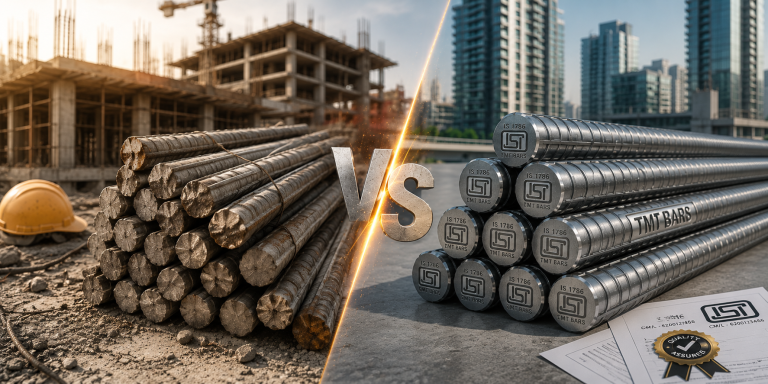
High ductility TMT bars deform safely without brittle failure, making them ideal for seismic zones.
Do High Ductility TMT Bars Perform Better With Concrete During Earthquakes?
Yes.
Because of:
-
Strong mechanical interlocking
-
Improved bond strength
-
Controlled strain distribution
-
Crack resistance in beam-column joints
Advanced structural-grade bars like Ambashakti SD and Flexion variants improve composite action between steel and concrete during seismic events.