
India’s steel industry is an important part of construction, infrastructure, manufacturing and economic development. As steel demand grows, manufacturers are also working to reduce the environmental impact associated with steel production.
This has increased interest in green steel manufacturing in India.
But what exactly is green steel? How is it manufactured? What technologies are used? How does it differ from conventional steel? And what does sustainable steel production mean for construction and infrastructure projects?
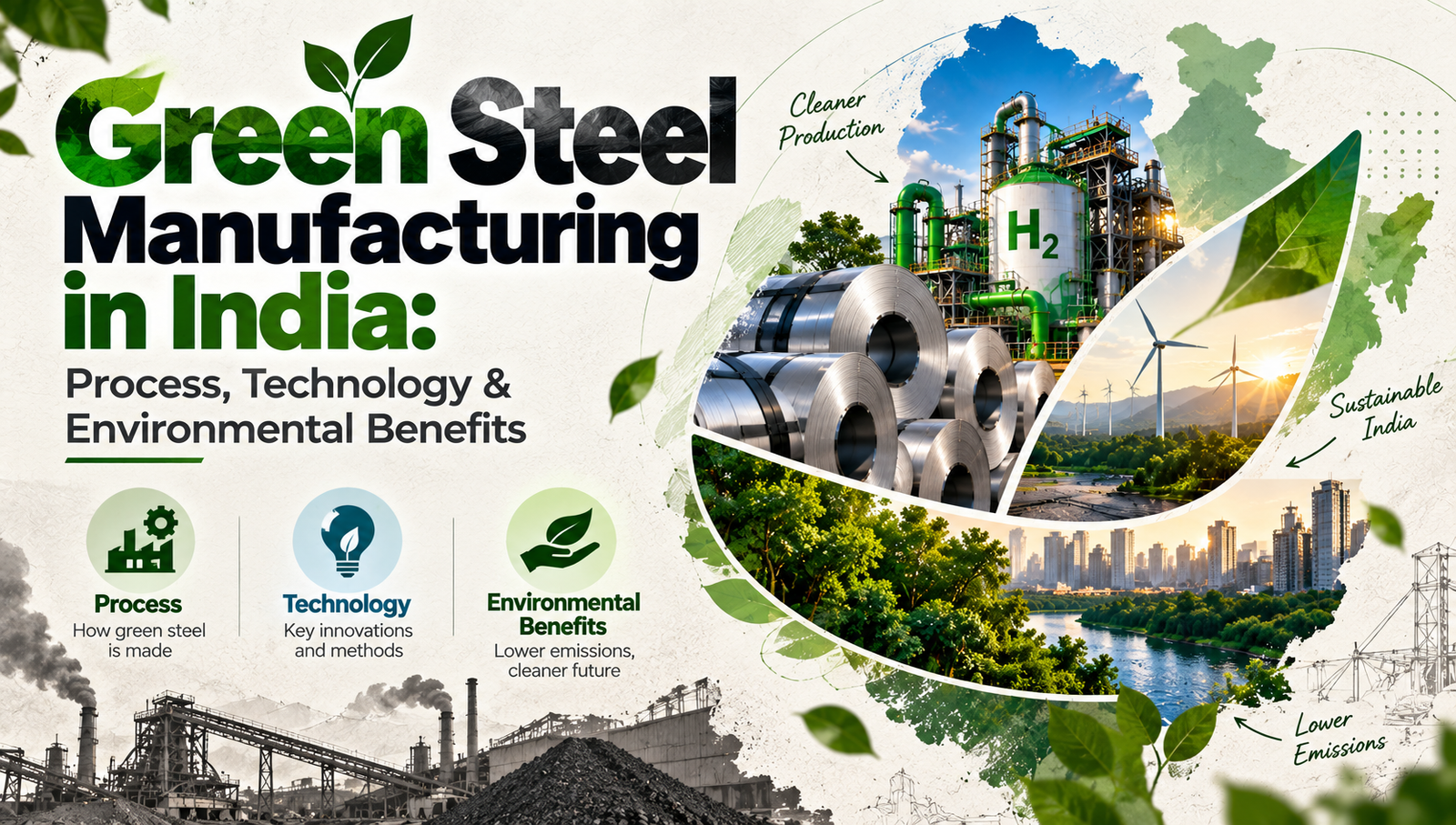
The answer involves a combination of raw-material selection, energy efficiency, recycled steel, Direct Reduced Iron (DRI), renewable energy, waste-heat recovery, process optimisation and emerging technologies such as green hydrogen.
This guide explains the green steel manufacturing process in India, the technologies supporting the transition, India’s Green Steel Taxonomy and the measures manufacturers can take to reduce the environmental footprint of steel production.
Quick answer: Green steel is steel produced with a lower emissions intensity through cleaner production routes, efficient energy use, recycled inputs, non-fossil energy and other decarbonisation measures. In India, the Ministry of Steel’s Green Steel Taxonomy defines green steel using a plant-level emissions-intensity threshold and star-rating framework.
What Is Green Steel?
Green steel generally refers to steel manufactured with a substantially lower environmental or greenhouse-gas emissions footprint than conventional production routes.
The exact definition can vary between countries and organisations. India now has a formal Green Steel Taxonomy, notified in December 2024, which provides a national framework for defining and rating green steel based on carbon-dioxide-equivalent emissions intensity.
Green steel production can involve:
- Recycled steel scrap
- Energy-efficient steelmaking
- Direct Reduced Iron
- Electric or induction melting
- Renewable electricity
- Waste-heat recovery
- Material efficiency
- Lower-carbon reducing agents
- Green hydrogen
- Carbon-management technologies
The important point is that green steel is not a different type of steel based on strength alone. It is primarily associated with the environmental performance of the manufacturing process.
What Is Green Steel Manufacturing?
Green steel manufacturing is the production of steel using processes and technologies designed to reduce greenhouse-gas emissions and improve resource efficiency.
A simplified steel production chain can look like:
Raw Materials → Ironmaking / Scrap Processing → Steel Melting → Refining → Continuous Casting → Billets → Rolling → Finished Steel
Sustainability opportunities can exist at every stage.
For example:
Raw materials: Increase suitable recycled scrap and improve material utilisation.
Energy: Use more efficient furnaces and lower-carbon electricity.
Heat: Recover energy that would otherwise be wasted.
Water: Recycle process water and reduce discharge.
Manufacturing: Integrate production stages to reduce unnecessary transport and reheating.
Future technologies: Introduce hydrogen-based reduction and other low-emission technologies as they become technically and commercially viable.
Green Steel Manufacturing in India
India is developing a formal policy framework for the transition toward lower-emission steel.
The Ministry of Steel released India’s Green Steel Taxonomy on 12 December 2024, and it was notified in the Gazette on 23 December 2024. The Ministry describes the taxonomy as a framework for promoting green technologies and developing the green-steel market in India.
Under the current taxonomy, green steel is defined using an emission-intensity threshold of less than 2.2 tonnes of CO₂e per tonne of finished steel.
The star-rating framework is:
| Green Steel Rating | Emission Intensity |
| 5-Star Green Steel | Below 1.6 tCO₂e/t finished steel |
| 4-Star Green Steel | 1.6–2.0 tCO₂e/t finished steel |
| 3-Star Green Steel | 2.0–2.2 tCO₂e/t finished steel |
| Not eligible for green rating | Above 2.2 tCO₂e/t finished steel |
The Ministry states that the threshold is subject to review every three years.
This gives Indian steel manufacturers and buyers a more defined framework for discussing green steel instead of relying only on broad sustainability terminology.
How Is Green Steel Made in India?
There is no single green steel manufacturing process.
Different manufacturers can use different combinations of technologies depending on raw-material availability, plant configuration, electricity supply and economics.
A lower-emission production pathway can include:
Step 1: Recycled Steel and Other Metallic Inputs
Steel scrap can be processed and reused as a metallic input.
Using suitable recycled steel can reduce dependence on virgin raw materials and support circular material use.
Step 2: DRI or Sponge Iron
Direct Reduced Iron can be used as an iron-bearing input for steelmaking.
The emissions profile of DRI depends on how it is produced and what reducing agent and energy source are used.
Step 3: Efficient Steel Melting
Metallic inputs are melted and refined in a furnace.
Depending on the plant, this can involve electric arc furnaces, induction furnaces or other steelmaking systems.
Step 4: Continuous Casting
Molten steel can be cast continuously into semi-finished products such as billets.
Step 5: Rolling
Billets are reheated or hot-charged and rolled into finished products such as TMT bars, angles, channels and other sections.
Step 6: Energy and Resource Recovery
Waste heat, process gases, water and other resources can be recovered and reused to improve efficiency.
Ambashakti describes a similar integrated manufacturing ecosystem covering raw-material processing, sponge iron, steel billets and finished steel products. Explore Ambashakti’s Steel Plants.
Green Steel Manufacturing Technologies
Several technologies can contribute to lower-emission steel production.
1. Recycled Steel Scrap
Recycled steel is one of the key inputs in circular steel production.
Steel can be recovered from end-of-life products, processed and remelted into new steel.
Benefits include:
- Reduced demand for some virgin raw materials
- Increased material circularity
- Reduced waste
- Potentially lower process emissions depending on the production route
Ambashakti’s Green Steel page identifies recycled steel scrap as a major input in its stated green-steel approach. Explore Ambashakti Green Steel.
2. Direct Reduced Iron
Direct Reduced Iron (DRI), also known as sponge iron, is an important iron-bearing material used in steelmaking.
The production route matters because different reductants have different emissions profiles.
India’s steel-transition roadmap identifies moving from coal-based DRI toward natural-gas-based DRI as one of the potential decarbonisation levers.
Ambashakti produces sponge iron/DRI as part of its integrated steelmaking system.
Explore Ambashakti Sponge Iron
3. Induction Furnace Technology
Induction furnaces use electromagnetic induction to melt metallic inputs.
Ambashakti’s billet-production information describes steel scrap and sponge iron being melted in high-efficiency induction furnaces, followed by chemical adjustment and continuous casting.
The environmental performance of electrically powered melting still depends on the electricity source, energy efficiency and raw-material mix.
4. Electric Arc Furnace Technology
Electric Arc Furnaces, or EAFs, use electricity to melt steel.
They can operate with large quantities of recycled steel scrap and can also use DRI.
The emissions intensity of EAF steel depends significantly on:
- Electricity source
- Scrap proportion
- DRI input
- Furnace efficiency
- Overall plant configuration
Therefore, an EAF should not automatically be considered green simply because it uses electricity.
5. Waste-Heat Recovery
Steel and DRI production generates heat that can otherwise be lost.
Waste-heat recovery systems can capture this energy and convert it into useful power or process heat.
Ambashakti states that hot gases from its DRI process are routed through waste-heat recovery boilers and used to generate captive power.
Learn About Ambashakti’s Sponge Iron Process
6. Renewable Energy
Renewable electricity can reduce emissions associated with electricity consumption in electrically powered processes.
Possible sources include:
- Solar
- Wind
- Hydropower
- Other low-carbon electricity
Ambashakti’s Green Steel information describes solar power and recovered captive power as part of its approach to reducing the carbon footprint of production.
7. Green Hydrogen
Green hydrogen is one of the emerging technologies for reducing emissions from primary steelmaking.
Instead of using a carbon-based reducing agent, hydrogen can be used to remove oxygen from iron ore.
A simplified reaction is:
Iron Oxide + Hydrogen → Iron + Water
India’s Ministry of Steel is supporting pilot projects for hydrogen use in steelmaking under the National Green Hydrogen Mission. The Ministry states that hydrogen-based green steel production is not yet commercially viable at scale in India and that pilot projects are being supported to develop the technology.
8. Carbon Capture, Utilisation and Storage
Carbon Capture, Utilisation and Storage, commonly called CCUS, is another pathway being evaluated for industrial decarbonisation.
India’s steel-sector roadmap identifies CCUS among the technology levers for reducing emissions from steel production.
The approach involves:
CO₂ generation → Capture → Transport → Utilisation or permanent storage
CCUS can be technically complex and requires suitable infrastructure and storage or utilisation options.
Ambashakti’s Green Steel Manufacturing Approach
Ambashakti currently presents its Green Steel approach around recycled inputs, recovered energy and efficient manufacturing processes.
According to Ambashakti’s Green Steel page, the approach includes:
- Recycled steel scrap
- In-house DRI
- Waste-heat recovery
- High-efficiency induction melting
- Captive power
- Solar power
- Integrated manufacturing
- Closed-loop water systems
- ISO 14001 environmental management
The company also states that its Green Steel TMT products meet the same IS 1786 requirements as conventional bars.
Explore Ambashakti Green Steel
This is important because sustainability and technical performance are separate considerations. Steel used for construction still has to meet its required grade, mechanical properties and applicable standards.
From Recycled Inputs to Finished Steel
Ambashakti’s stated integrated route can be simplified as:
Recycled Scrap + DRI
↓
Steel Melting
↓
Continuous Casting
↓
Steel Billets
↓
Rolling
↓
TMT Bars / Structural Steel
The billet stage is particularly important because billets are the semi-finished material used to manufacture many long-steel products.
Ambashakti’s billet page states that its billets are produced using induction furnace melting and continuous casting, with IS 2830 certification, and are used for products such as TMT bars, angles and channels.
Explore Ambashakti Steel Billets
Why Steel Billets Matter in Green Steel Manufacturing
A billet is not the final steel product. It is an intermediate product that is subsequently rolled into finished steel.
The quality of billets influences:
- Chemical consistency
- Mechanical performance
- Dimensional accuracy
- Surface quality
- Rolling consistency
- Finished-product performance
Ambashakti describes its billet production as an integrated stage connecting steel melting, continuous casting and downstream rolling.
This integration can also provide opportunities for improving energy and material efficiency.
Sustainable Steel Production: What Does It Mean?
Sustainable steel production is broader than simply reducing carbon emissions.
It can involve:
Environmental Performance
Reducing greenhouse-gas emissions, energy consumption, water consumption and industrial waste.
Resource Efficiency
Using raw materials efficiently and increasing circular use of steel scrap.
Energy Recovery
Recovering waste heat and improving energy utilisation.
Process Efficiency
Reducing unnecessary transport, reheating, processing losses and material wastage.
Product Durability
Manufacturing steel that performs reliably over its intended service life.
Circularity
Recovering and recycling steel at the end of its useful life.
India’s Ministry of Steel identifies several levers for greening the steel sector, including energy efficiency, renewable energy, green hydrogen, material efficiency, alternative DRI pathways, CCUS and biochar.
Green Steel vs Conventional Steel
| Factor | Green Steel Manufacturing | Conventional Production |
| Raw materials | Can increase recycled inputs | May rely more heavily on virgin materials depending on route |
| Energy | Focus on efficiency and lower-carbon sources | Varies by plant and process |
| Waste heat | Can be recovered and reused | Depends on plant |
| Water | Can use recycling and closed-loop systems | Depends on facility |
| Carbon emissions | Designed to reduce emissions intensity | Varies considerably by production route |
| Technology | May use newer lower-emission processes | Often established production technologies |
| Circularity | Greater emphasis on recycling | Varies by production route |
| Product strength | Must meet required standards | Must meet required standards |
Green steel should therefore be evaluated using measured emissions data and the relevant national or industry framework, rather than by the name alone.
Is Green Steel the Same as Low-Carbon Steel?
The terms overlap, but they are not necessarily identical.
Low-carbon steel generally describes steel produced with a lower greenhouse-gas emissions intensity than a defined baseline.
Green steel is a broader term, but India now has a formal taxonomy with specific emissions-intensity thresholds and ratings.
This means Indian buyers can increasingly ask for measurable information rather than relying only on general sustainability language.
What Is India’s Green Steel Taxonomy?
India’s Green Steel Taxonomy was released by the Ministry of Steel in December 2024.
It establishes:
- A green-steel emissions threshold
- Green percentage calculation
- Three-, four- and five-star classifications
- Measurement, reporting and verification requirements
Under the framework, steel with emissions intensity below 2.2 tCO₂e per tonne of finished steel can qualify for a green rating, subject to the applicable methodology.
The current categories are:
| Rating | Emission Intensity |
| 5-Star | < 1.6 tCO₂e/t finished steel |
| 4-Star | 1.6–2.0 tCO₂e/t finished steel |
| 3-Star | 2.0–2.2 tCO₂e/t finished steel |
| No Green Rating | > 2.2 tCO₂e/t finished steel |
The Ministry also states that the National Institute of Secondary Steel Technology (NISST) is the nodal agency for measurement, reporting and verification and for issuing green-steel certificates and star ratings.
How Much Green Steel Is India Producing?
Green-steel adoption in India has moved beyond policy development into certification.
According to the Ministry of Steel’s current Green Steel Initiative information, 90 steel units were awarded green-steel certification during FY 2025–26, representing a combined 12.4 million tonnes of green-steel production.
This indicates that green-steel manufacturing is becoming a measurable part of India’s steel-sector transition rather than remaining only a future concept.
Benefits of Green Steel Manufacturing
Lower Emissions Intensity
The primary objective is to reduce greenhouse-gas emissions per tonne of steel.
Better Resource Efficiency
Using recycled scrap and recovering waste energy can improve resource utilisation.
Reduced Waste
Circular use of steel helps keep material in productive use instead of sending it to waste streams.
Energy Recovery
Waste-heat systems can turn otherwise lost thermal energy into useful power.
Water Efficiency
Closed-loop water systems can reduce freshwater demand and industrial discharge.
Support for Sustainable Construction
Lower-emission steel can help construction projects address embodied-carbon and broader sustainability objectives.
Challenges of Green Steel Manufacturing in India
Green steel production also faces practical challenges.
Availability of High-Quality Scrap
Steel demand is large, while the availability of suitable end-of-life scrap is limited.
Energy Requirements
Electrified steelmaking requires reliable electricity, and the carbon intensity of that electricity matters.
Hydrogen Cost
Green hydrogen production requires substantial renewable electricity and infrastructure.
Capital Investment
New furnaces, renewable-power systems, hydrogen equipment and carbon-management systems require significant investment.
Carbon Measurement
Different methodologies and boundaries can make comparisons difficult.
Technology Scale
Some green-steel technologies are proven at smaller or pilot scale but still require further commercial deployment.
How Is Green Steel Different from Carbon-Neutral Steel?
These terms should not be treated as identical.
Green steel in India can now be assessed through the country’s Green Steel Taxonomy and emissions-intensity thresholds.
Carbon-neutral steel generally involves balancing residual greenhouse-gas emissions through a defined accounting and removal framework.
Therefore, a product can be described as lower-carbon or green under a particular framework without automatically being carbon-neutral.
For more information, see Ambashakti’s Green Steel page and its educational content on Sustainable Steel vs Conventional Steel.
Green Steel and TMT Bars
Green manufacturing does not eliminate the technical requirements for construction steel.
TMT bars must still be evaluated for:
- Grade
- Yield strength
- Tensile strength
- Ductility
- Diameter
- Weight
- Rib pattern
- Applicable standard
- Quality documentation
- Traceability
Ambashakti’s current TMT range includes FE550CRS, FE550D and FE550, with TMT product information covering IS 1786 certification and testing.
For specific products:
How Can Construction Buyers Evaluate Green Steel?
Before purchasing green or sustainable steel, buyers can ask manufacturers for:
1. Emissions Intensity
What is the CO₂e emissions intensity per tonne of finished steel?
2. Production Boundary
Does the calculation cover Scope 1, Scope 2 and applicable Scope 3 emissions?
3. Raw-Material Mix
What proportion of the steel comes from scrap, DRI and other inputs?
4. Energy Source
What percentage of electricity comes from renewable, recovered or conventional sources?
5. Green Steel Rating
If applicable, does the product or plant have a certification under India’s Green Steel Taxonomy?
6. Verification
Who measured or verified the emissions data?
7. Product Certification
Does the steel still meet the required BIS/IS or project-specific technical standard?
This creates a more meaningful comparison than simply choosing a product labelled “green.”
The Future of Green Steel Manufacturing in India
India’s steel decarbonisation pathway is likely to involve multiple technologies rather than one universal production route.
Key areas include:
- Higher use of scrap
- Energy-efficient steelmaking
- Renewable electricity
- DRI optimisation
- Natural-gas-based DRI
- Green hydrogen
- Electric furnaces
- Waste-heat recovery
- Material efficiency
- CCUS
- Biochar and other emerging approaches
The Ministry of Steel’s roadmap explicitly identifies these technology and process levers as part of India’s green transition.
The Ministry also notes that hydrogen-based green-steel production is still at the development and pilot stage in India, with government-supported projects exploring multiple hydrogen applications.
Frequently Asked Questions
What is green steel manufacturing?
Green steel manufacturing is the production of steel using processes, raw materials, energy systems and technologies designed to lower the environmental and greenhouse-gas footprint of steel production.
How is green steel made in India?
Green steel can be produced using combinations of recycled steel, DRI, efficient electric or induction melting, renewable energy, waste-heat recovery and other lower-emission technologies. India’s Green Steel Taxonomy provides a national emissions-based framework for green-steel classification.
What is sustainable steel production?
Sustainable steel production focuses on improving environmental and resource performance through measures such as lower emissions, energy efficiency, recycling, water conservation, waste recovery and material efficiency.
What is India’s Green Steel Taxonomy?
India’s Green Steel Taxonomy is a national framework released by the Ministry of Steel in December 2024 that defines green steel using emissions-intensity thresholds and star ratings. Steel below 2.2 tCO₂e per tonne of finished steel can qualify for a green rating subject to the methodology.
What is 5-star green steel in India?
Under India’s current taxonomy, five-star green-rated steel has an emissions intensity below 1.6 tCO₂e per tonne of finished steel.
Is recycled steel green steel?
Recycled steel can contribute to lower-carbon steel production, but recycled content alone does not automatically qualify a product as green steel. The applicable emissions-intensity methodology and certification framework must be considered.
Is green steel more expensive?
The cost depends on the technology, raw materials, electricity, scale, location and market conditions. Some lower-emission technologies can involve higher upfront investment.
Is green steel as strong as conventional steel?
Green manufacturing and mechanical strength are separate attributes. A steel product must still meet the required grade and applicable technical standards for its intended use.
How does Ambashakti manufacture green steel?
Ambashakti describes its Green Steel approach as using recycled steel scrap, in-house DRI, waste-heat recovery, high-efficiency induction melting, captive power, solar power and closed-loop water management.
What is the role of sponge iron in green steel production?
Sponge iron or DRI can provide an iron-bearing input for steelmaking. Its environmental performance depends on the reduction technology, energy source and reductant used.
What is the role of steel billets?
Billets are semi-finished steel products produced after steel melting and casting. They are subsequently rolled into products such as TMT bars, angles and channels.
Related Ambashakti Resources
What Is Green Steel? Benefits, Manufacturing Process & Future Applications
Understand the fundamentals of green steel, its benefits, manufacturing technologies and future applications.
Green Steel Manufacturing Process Explained
Explore the stages from raw materials through steelmaking and finished steel production.
Read the Green Steel Manufacturing Process Guide
Sustainable Steel vs Conventional Steel
Compare sustainable and conventional steel production, including energy, raw materials, emissions and resource efficiency.
Read Sustainable Steel vs Conventional Steel
Low-Carbon Steel Production
Understand the technologies, benefits and challenges associated with lower-carbon steel manufacturing.
Read the Low-Carbon Steel Guide
Carbon-Neutral Steel
Learn how carbon-neutral steel differs from low-carbon and green steel and how carbon accounting works.
Read the Carbon-Neutral Steel Guide
Ambashakti Green Steel
Explore Ambashakti’s stated Green Steel manufacturing approach.
Steel Billets
Learn about billet manufacturing, continuous casting and the role of billets in finished steel products.
Sponge Iron
Learn about DRI/sponge iron production and its role in steelmaking.
Steel Plants
Explore Ambashakti’s manufacturing facilities and integrated steel production ecosystem.
Final Takeaway
Green steel manufacturing in India is moving from a broad sustainability concept toward a measurable emissions-based framework.
India’s Green Steel Taxonomy provides a national system for classifying steel based on emissions intensity, with green ratings beginning below 2.2 tCO₂e per tonne of finished steel and five-star green steel defined below 1.6 tCO₂e/t finished steel.
Sustainable steel production can involve a combination of:
Recycled Scrap + DRI + Efficient Melting + Renewable/Recovered Energy + Waste-Heat Recovery + Process Efficiency + Emerging Low-Carbon Technologies
Ambashakti describes its own Green Steel approach around recycled steel scrap, in-house DRI, waste-heat recovery, high-efficiency induction melting, captive and solar power, integrated manufacturing and closed-loop water systems.
For construction buyers, the next step is to evaluate both environmental performance and technical performance: emissions data, certification, grade, strength, ductility, quality documentation and project suitability.