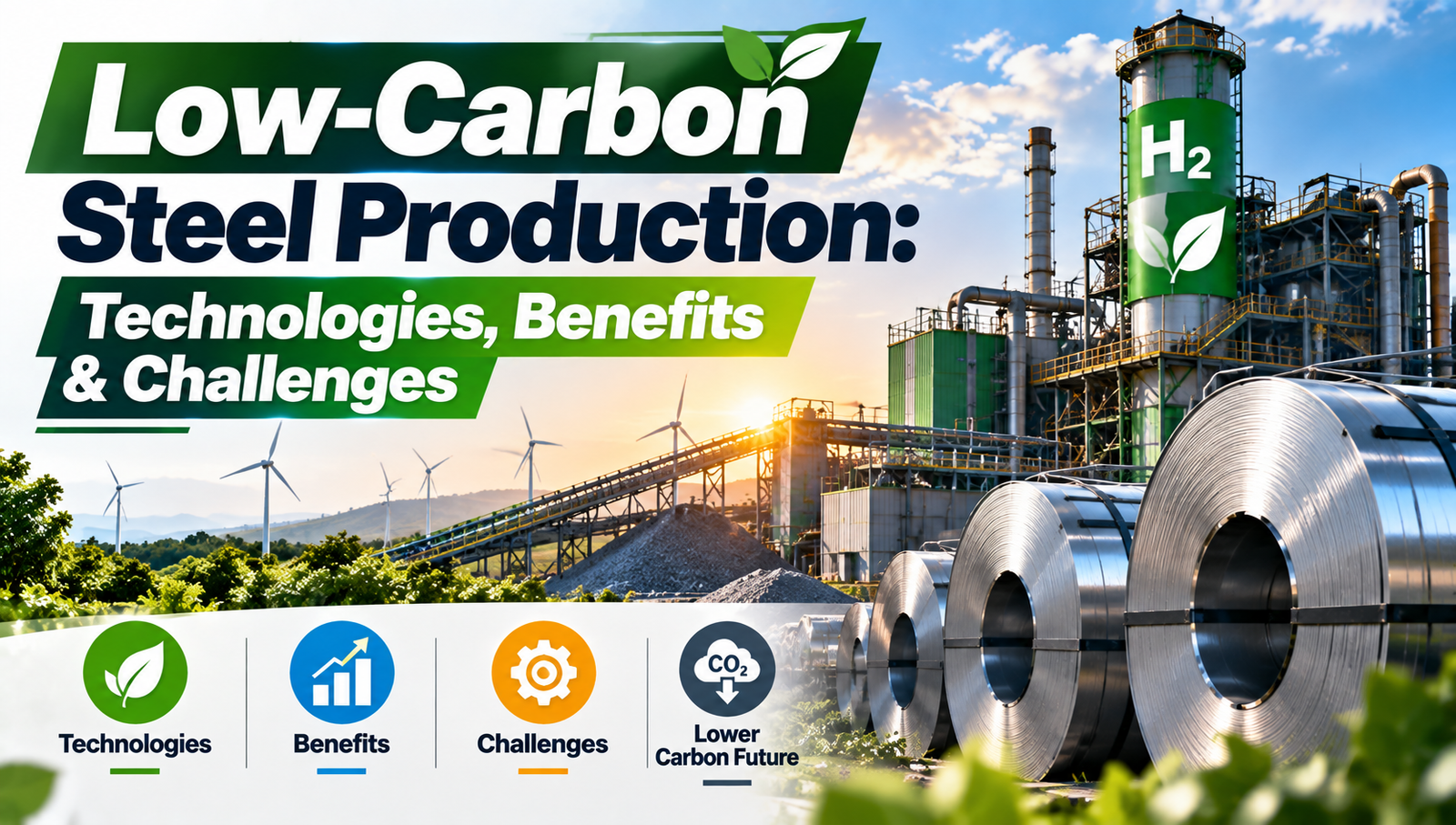

Low-Carbon Steel Production: Technologies, Benefits & Challenges
Steel is essential for construction, infrastructure, transportation, manufacturing and energy systems. At the same time, steelmaking is an energy-intensive industrial activity, which makes reducing its greenhouse-gas emissions an important part of industrial decarbonisation.
This has led to growing interest in low-carbon steel production.
Low-carbon steel production focuses on reducing the greenhouse-gas emissions associated with making steel compared with a defined conventional or baseline production route. This can involve using more recycled steel, improving energy efficiency, recovering waste heat, using lower-carbon electricity, changing the ironmaking process and adopting emerging technologies such as hydrogen-based direct reduced iron.
There is no single technology that defines low-carbon steel. The most suitable approach depends on available raw materials, energy sources, existing plant configuration, technology maturity, cost and regional infrastructure.
This guide explains what low-carbon steel production means, how low-carbon steel is made, the technologies being used, the role of scrap and DRI, the challenges involved and how manufacturers such as Ambashakti are working to reduce the footprint of steel production.
Quick Answer: What Is Low-Carbon Steel Production?
Low-carbon steel production means producing steel with a lower greenhouse-gas emissions intensity than a defined conventional or baseline production route.
The main approaches include:
- Increasing the use of recycled steel
- Improving energy efficiency
- Using Direct Reduced Iron (DRI)
- Using electric or induction-based melting where appropriate
- Increasing the share of lower-carbon electricity
- Recovering waste heat
- Improving process integration
- Reducing material and energy losses
- Developing hydrogen-based ironmaking
- Exploring carbon capture and other emerging technologies
The actual carbon intensity depends on the production route, electricity source, raw-material mix and plant-level operating conditions.
The International Energy Agency identifies several pathways for steel decarbonisation, including increased use of scrap-based electric furnaces, DRI, hydrogen, direct electrification and carbon-capture technologies.
Why Does Steel Production Need to Become Lower Carbon?
Steel manufacturing contributes a significant share of global industrial greenhouse-gas emissions.
According to the World Steel Association, the average greenhouse-gas emissions intensity of global steel production in 2024 was approximately 2.18 tonnes of CO₂e per tonne of crude steel across its reported scopes. The association also notes that emissions vary substantially by production route.
The largest differences occur in the way iron is produced.
In conventional ore-based production, iron is produced from iron ore through processes that can use coal or natural gas. In scrap-based production, recycled steel can be melted directly in an electric furnace.
This makes the ironmaking stage, energy source and raw-material mix important factors in reducing steel’s carbon intensity.
What Is Low-Carbon Steel?
Low-carbon steel is not simply a different grade of steel.
The term generally refers to the environmental footprint of producing the steel, particularly its greenhouse-gas emissions intensity.
This distinction is important.
Two steel products could have similar mechanical properties and meet the same product standard while being produced using different manufacturing routes with different environmental footprints.
For construction steel, buyers should therefore evaluate two separate questions:
Does the product meet the required technical standard?
and
What is the documented environmental footprint of producing it?
How Is Low-Carbon Steel Produced?
There are several pathways to reducing the carbon intensity of steel production.
A simplified process can look like:
Raw Materials → Ironmaking / Scrap Preparation → Steel Melting → Refining → Casting → Rolling → Finished Steel
The biggest opportunities for emissions reduction occur through changes to the raw materials, ironmaking method, electricity source and energy efficiency of the process.
1. Increasing Recycled Steel Use
Recycling is one of the most established approaches to reducing the environmental impact of steel production.
Steel scrap can be collected, processed and remelted to manufacture new steel products.
The World Steel Association notes that scrap can be used in different steelmaking routes and that increasing scrap use can reduce demand for virgin raw materials and lower emissions.
However, scrap availability is limited by the amount of steel reaching end of life and the quality of available scrap. Global steel demand cannot currently be met entirely through scrap because insufficient quantities are available.
This means low-carbon steelmaking will require a combination of technologies and raw-material strategies.
2. Electric Arc Furnaces
Electric Arc Furnaces, or EAFs, use electricity to melt steel.
EAFs can operate with high proportions of recycled steel and can also use DRI or other iron-bearing materials.
Their emissions profile depends heavily on the electricity source.
An EAF supplied primarily by low-carbon electricity can have a substantially lower emissions intensity than an EAF supplied by carbon-intensive electricity.
World Steel Association data for 2024 shows average emissions intensity of approximately 0.69 tonnes CO₂ per tonne of crude steel for scrap-EAF, compared with approximately 2.34 tonnes for BF-BOF, using its stated methodology.
This does not mean every EAF is automatically low carbon. The raw-material mix, electricity source and plant efficiency matter.
3. Induction Furnace Technology
Induction furnaces use electromagnetic energy to melt metallic charge materials.
In regions such as India, induction furnaces are used in steelmaking and can operate using combinations of scrap, DRI and other metallic inputs.
Their environmental performance depends on:
- Electricity source
- Energy efficiency
- Raw-material mix
- Furnace efficiency
- Process integration
- Waste-heat utilisation
Ambashakti’s Green Steel information describes the use of high-efficiency induction melting as one element of its approach to reducing the footprint of its steel production.
Explore Ambashakti Green Steel
4. Direct Reduced Iron
Direct Reduced Iron, or DRI, is produced by removing oxygen from iron ore without melting the ore completely.
DRI can be produced using different reductants, including natural gas or coal, and emerging processes can use hydrogen.
The carbon footprint therefore depends strongly on how the DRI is produced.
World Steel Association data shows that DRI-EAF generally has a lower emissions intensity than BF-BOF, although it remains more carbon-intensive than scrap-EAF in the association’s 2024 global averages.
Ambashakti produces DRI, also known as sponge iron, and uses it as an iron-bearing input for steelmaking.
Explore Ambashakti Sponge Iron
5. Hydrogen-Based DRI
Hydrogen is one of the most discussed technologies for deep decarbonisation of primary steelmaking.
In conventional reduction, carbon-containing materials remove oxygen from iron ore.
In hydrogen-based reduction, hydrogen can act as the reducing agent, with water produced as the main reaction product rather than carbon dioxide at the reduction stage.
A simplified reaction is:
Iron Ore + Hydrogen → Iron + Water
The World Steel Association identifies hydrogen-based reduction as one of the potential breakthrough pathways for low-carbon steelmaking.
The International Energy Agency also identifies hydrogen-based DRI combined with electric furnaces as an emerging low-emissions pathway.
However, hydrogen-based steelmaking still faces challenges involving:
- Hydrogen availability
- Low-carbon hydrogen production
- Renewable electricity requirements
- Capital investment
- Infrastructure
- Technology scale-up
- Cost competitiveness
6. Renewable Electricity
The electricity used by an electric or induction furnace affects the carbon footprint of the resulting steel.
Using lower-carbon electricity can therefore reduce emissions associated with melting and refining.
Sources can include:
- Solar power
- Wind power
- Hydropower
- Nuclear power
- Other low-carbon electricity sources
Ambashakti’s Green Steel page describes solar power and captive power generated through recovered energy as part of its approach to lower-carbon production.
Explore Ambashakti Green Steel
7. Waste-Heat Recovery
Steel and ironmaking processes generate substantial amounts of heat.
Instead of allowing useful heat to escape, waste-heat recovery systems can capture thermal energy and convert it into useful power or heat.
This can improve overall energy efficiency.
Ambashakti states that hot gases from its DRI process are routed through waste-heat recovery boilers to generate captive electricity.
Learn About Ambashakti Sponge Iron
8. Process Integration
Integrating multiple stages of steel production can reduce unnecessary transportation, reheating and energy losses.
A simplified integrated route can connect:
Raw Materials → Sponge Iron → Steel Melting → Billets → Rolling → Finished Steel
Ambashakti describes an integrated manufacturing model covering raw-material processing, sponge iron, steel billets and finished steel products.
Explore Ambashakti Steel Plants
Low-Carbon Steel Production Technologies Compared
| Technology / Approach | Main Decarbonisation Mechanism | Key Consideration |
| Recycled Steel / Scrap | Reduces need for virgin ironmaking | Scrap availability and quality |
| Scrap-EAF | Melts scrap using electricity | Electricity carbon intensity |
| DRI-EAF | Uses reduced iron with electric melting | Reductant and power source |
| Hydrogen DRI | Replaces carbon reductant with hydrogen | Green hydrogen availability |
| Induction Furnace | Electric melting of metallic inputs | Power source and charge mix |
| Waste-Heat Recovery | Converts waste heat into useful energy | Site/process configuration |
| Renewable Power | Lowers electricity-related emissions | Availability and grid integration |
| CCUS | Captures CO₂ from process streams | Cost, infrastructure and storage |
| Process Integration | Reduces energy and transport losses | Plant configuration |
No single technology is sufficient for every plant or region. The most practical pathway depends on local raw-material availability, electricity supply, technology maturity and economics.
Low-Carbon Steel vs Conventional Steel
The main difference is generally in how the steel is produced, not necessarily how the finished product performs.
| Factor | Low-Carbon Steel Production | Conventional Production |
| Carbon emissions | Designed to reduce emissions intensity | Can have higher emissions depending on route |
| Scrap use | Often prioritised where available | Varies by process |
| Energy efficiency | Major focus | Varies by plant |
| Renewable electricity | May be integrated | Depends on facility |
| Waste-heat recovery | Can reduce energy losses | Depends on facility |
| Hydrogen | Emerging option | Generally not the primary reductant |
| Product quality | Must meet applicable standards | Must meet applicable standards |
| Technology | May combine established and emerging technologies | Often established production routes |
It is important not to assume that every product labelled “green” or “low carbon” has the same carbon footprint. A meaningful comparison requires a defined measurement boundary and reliable emissions data.
What Is the Carbon Footprint of Steel?
Carbon footprint refers to the greenhouse-gas emissions associated with producing a product or service.
For steel, the result can depend on whether the calculation includes:
- Raw-material extraction
- Transport
- Ironmaking
- Steelmaking
- Electricity
- Rolling
- Downstream processing
- Other Scope 1, 2 and 3 emissions
The World Steel Association notes that multiple greenhouse-gas accounting methodologies exist for steel, making consistent measurement and comparison important.
Therefore, when comparing two “low-carbon” steel products, buyers should look for:
- Emissions per tonne of steel
- Scope boundaries
- Measurement methodology
- Production year
- Product-specific or facility-level data
- Third-party verification where available
Challenges in Low-Carbon Steel Production
Moving toward low-carbon steel is technically possible but involves significant challenges.
High Capital Investment
New furnaces, hydrogen systems, renewable-power infrastructure, carbon-capture equipment and other technologies require substantial investment.
Availability of Scrap
Scrap-based steelmaking is attractive from a carbon perspective, but global scrap availability is not sufficient to meet all steel demand.
Availability of Low-Carbon Electricity
Electric furnaces can lower emissions, but their environmental advantage depends partly on how the electricity is generated.
Hydrogen Cost and Infrastructure
Hydrogen-based DRI requires large quantities of hydrogen and electricity, along with storage and transport infrastructure.
The IEA notes that hydrogen-DRI-EAF is emerging as an important low-emissions route, but cost remains a barrier to rapid deployment.
Existing Plant Assets
Steel plants have long operating lives, making a complete transition difficult and expensive.
Carbon Accounting
Different accounting boundaries and methodologies can make it difficult to compare claims made by different producers.
How Ambashakti Is Working Toward Lower-Carbon Steel Production
Ambashakti’s Green Steel page describes a production approach based on recycled steel scrap, in-house DRI, recovered waste heat, high-efficiency induction melting, captive power and solar power. It also states that its applicable green-steel products meet IS 1786 requirements.
The company’s sustainability approach includes several interconnected stages.
Recycled Steel Scrap
Recycled scrap is used as a significant part of the melting charge.
Explore Green Steel at Ambashakti
In-House DRI
Ambashakti produces sponge iron/DRI for use as an iron-bearing input in its steelmaking process.
Explore Ambashakti Sponge Iron
Waste-Heat Recovery
Waste gases from DRI operations are used through waste-heat recovery systems to generate captive power. (Ambashakti)
High-Efficiency Melting
Ambashakti describes high-efficiency induction furnaces as part of its steelmaking process. (Ambashakti)
Integrated Manufacturing
Its manufacturing system connects raw materials, sponge iron, billets and finished steel products.
From DRI and Scrap to Low-Carbon Steel
A simplified representation of Ambashakti’s stated manufacturing approach is:
Recycled Scrap + In-House DRI
↓
Efficient Steel Melting
↓
Continuous Casting
↓
Steel Billets
↓
Rolling
↓
TMT Bars / Structural Steel
The billet stage is particularly important because billets form the intermediate product from which several finished long-steel products are rolled.
Low-Carbon Steel and TMT Bars
Lower-carbon production does not remove the need for technical performance.
For TMT reinforcement steel, buyers should still check:
- Grade
- Yield strength
- Tensile strength
- Ductility
- Diameter
- Weight
- Rib geometry
- Applicable BIS/IS standard
- Test documentation
- Traceability
Ambashakti’s TMT range includes FE550, FE550D and FE550CRS, with its product information covering IS 1786 compliance and manufacturing quality.
You can also explore:
Low-Carbon Steel for Sustainable Construction
Construction companies are increasingly considering the environmental footprint of materials alongside structural performance and cost.
Using lower-carbon steel can form part of a broader strategy to reduce embodied emissions in:
- Residential buildings
- Commercial buildings
- Industrial facilities
- Bridges
- Roads
- Rail infrastructure
- Warehouses
- Renewable-energy infrastructure
However, the carbon footprint of a building depends on all major materials and construction activities, not steel alone.
For procurement teams, a useful evaluation framework is:
Technical Performance + Carbon Footprint + Certification + Cost + Availability
How Buyers Can Evaluate Low-Carbon Steel
A sustainability claim should ideally be supported by measurable information.
Before purchasing, ask:
1. What is the carbon intensity?
Look for emissions reported per tonne of steel.
2. What is the measurement boundary?
Confirm whether the figure covers Scope 1, Scope 2 and Scope 3 emissions and what stages are included.
3. What raw materials are used?
Ask about recycled steel, DRI and other inputs.
4. What is the electricity source?
Electricity can have a significant effect on the emissions profile of electrically melted steel.
5. Is waste heat recovered?
Waste-heat recovery can improve energy utilisation.
6. Is the claim independently verified?
Third-party assurance can make environmental claims easier to evaluate.
7. Does the product meet the required standard?
Sustainability should complement, not replace, engineering and quality requirements.
Low-Carbon Steel vs Green Steel
The two terms are closely related but are not necessarily interchangeable.
Low-carbon steel generally refers to steel with a lower greenhouse-gas emissions intensity relative to a defined benchmark.
Green steel is a broader market term that is often used for steel produced with substantially reduced environmental impact, cleaner energy or lower-carbon technologies.
Because terminology and thresholds can differ, buyers should examine the actual emissions data and methodology behind a product claim.
Ambashakti’s Green Steel page describes its own approach as using recycled inputs, recovered energy, captive power and solar power while maintaining applicable product standards.
Explore Ambashakti Green Steel
The Future of Low-Carbon Steel Production
The transition toward lower-carbon steel is likely to involve multiple technologies rather than a single solution.
Key areas include:
- Higher scrap recycling
- Electric furnaces
- Lower-carbon DRI
- Hydrogen-based ironmaking
- Renewable electricity
- Waste-heat recovery
- Carbon capture
- Process optimisation
- Digital energy management
- Improved material efficiency
The IEA and World Steel Association both describe a portfolio approach in which technologies are deployed according to regional resources, infrastructure and economics.
Frequently Asked Questions About Low-Carbon Steel Production
What is low-carbon steel production?
Low-carbon steel production means manufacturing steel with a lower greenhouse-gas emissions intensity than a defined conventional or baseline production route.
How is low-carbon steel made?
It can be produced through approaches such as increased scrap use, electric or induction melting, DRI, renewable electricity, waste-heat recovery, hydrogen-based reduction and other efficiency or carbon-reduction technologies.
Is recycled steel low carbon?
Recycled steel can reduce the need for virgin ironmaking and can have a lower emissions intensity, particularly in scrap-based electric-furnace production. The overall footprint still depends on the electricity source and process used.
Is EAF steel low carbon?
EAF steel can have a lower emissions intensity than BF-BOF steel, but the result depends on the raw-material mix and electricity source.
What is hydrogen-based steelmaking?
Hydrogen-based steelmaking uses hydrogen as a reducing agent to remove oxygen from iron ore. The reduction reaction produces water rather than CO₂ as the main reaction product at that stage.
Is hydrogen steelmaking commercially available?
Hydrogen-based steelmaking is developing rapidly, but large-scale deployment still faces challenges involving hydrogen availability, renewable electricity, infrastructure and cost.
What is the role of DRI in low-carbon steel production?
DRI provides an iron-bearing input for steelmaking. Natural-gas-based DRI can have a lower emissions intensity than blast-furnace production, while hydrogen-based DRI is being developed as a pathway for deeper emissions reductions.
How does waste-heat recovery reduce emissions?
Waste-heat recovery captures thermal energy that would otherwise be lost and converts it into useful power or heat, improving overall energy efficiency.
Does low-carbon steel have the same strength as conventional steel?
Low-carbon production describes the manufacturing footprint rather than a separate strength category. The finished steel must meet the required product standard, grade and mechanical specifications.
How does Ambashakti produce lower-carbon steel?
Ambashakti describes its Green Steel approach as using recycled scrap, in-house DRI, recovered waste heat, efficient induction melting, captive power and solar power. (Ambashakti Green Steel).
Related Ambashakti Resources
What Is Green Steel? Benefits, Manufacturing Process & Future Applications
Understand the meaning of green steel, its technologies, benefits and future applications.
Green Steel Manufacturing Process Explained
Learn how steel moves from raw materials through melting, casting and rolling, and where sustainability measures can be introduced.
Read the Green Steel Manufacturing Guide
Sustainable Steel vs Conventional Steel
Compare sustainable and conventional steel production, including raw materials, energy efficiency, emissions and water management.
Read the Sustainable Steel Guide
Ambashakti Green Steel
Explore Ambashakti’s approach to recycled inputs, recovered energy, captive power, solar power and resource efficiency.
Steel Billets
Learn how steel billets are manufactured and used as an intermediate product for TMT bars and structural steel.
Sponge Iron
Understand DRI production and its role in integrated steel manufacturing.
TMT Bars
Explore Ambashakti’s TMT products, grades, specifications and quality information.
Final Takeaway
Low-carbon steel production is not one manufacturing technology. It is a combination of process choices that can reduce greenhouse-gas emissions per tonne of steel.
The main pathways include greater use of recycled steel, electric and induction melting, DRI, renewable electricity, waste-heat recovery, process integration and emerging technologies such as hydrogen-based ironmaking.
The most effective approach depends on the local availability of scrap, iron ore, energy, hydrogen, technology and infrastructure.
For construction buyers, low-carbon steel should be evaluated using the same technical criteria applied to conventional steel — including strength, ductility, applicable standards and quality certification — while also examining the manufacturer’s documented environmental performance.
Ambashakti’s Green Steel approach combines recycled scrap, in-house DRI, recovered waste heat, high-efficiency induction melting and solar/captive power as part of its stated lower-carbon manufacturing strategy.