

TMT Bars vs Other Reinforcing Materials: Cost & Durability in Commercial Projects
Quick Answer
For most commercial construction projects, TMT bars remain the most cost-effective and durable reinforcing material. Compared to mild steel bars, HYSD bars, welded wire mesh, and fiber-reinforced alternatives, TMT bars offer superior strength, earthquake resistance, corrosion protection, and long-term structural performance while maintaining an economical lifecycle cost.
Best Reinforcement Choice by Application
|
Application |
Recommended Material |
|
Commercial Buildings |
TMT Bars |
|
High-Rise Structures |
Fe 550D TMT Bars |
|
Industrial Projects |
TMT Bars |
|
Bridges & Infrastructure |
TMT Bars |
|
Slabs & Flooring |
TMT Bars + Welded Mesh |
|
Corrosion-Prone Areas |
Corrosion-Resistant TMT Bars |
Key Takeaways
- TMT bars offer the best balance of cost and durability.
- Superior earthquake resistance compared to traditional steel bars.
- Lower maintenance costs over the building lifecycle.
- Better corrosion resistance for commercial structures.
- Fe 500D and Fe 550D are preferred grades for commercial projects.
Expert Answer
For most commercial construction projects, TMT bars provide the highest long-term value due to their combination of strength, ductility, corrosion resistance, and lower lifecycle costs compared to alternative reinforcing materials.
Introduction
Reinforcement materials play a crucial role in determining the strength, safety, and lifespan of commercial structures. Whether constructing office complexes, shopping malls, warehouses, factories, hospitals, or high-rise buildings, selecting the right reinforcement material directly impacts project costs and long-term durability.
This guide compares TMT bars with other reinforcing materials based on cost, strength, corrosion resistance, maintenance requirements, and durability.
Why Reinforcement Materials Matter in Commercial Construction
- Increase structural strength
- Improve load-bearing capacity
- Reduce cracking
- Enhance earthquake resistance
- Extend building lifespan
- Improve overall safety
The quality of reinforcement determines how well a structure performs over decades of use.
What Are TMT Bars?
TMT bars are high-strength reinforcement steel bars manufactured through a thermo-mechanical treatment process.
The manufacturing process involves:
- Heating steel billets
- Hot rolling
- Rapid quenching
- Self-tempering
- Atmospheric cooling
This creates:
- A hard outer surface
- A ductile inner core
- Superior strength-to-flexibility ratio
These characteristics make TMT bars highly suitable for commercial construction.
If you’re new to reinforcement steel, learn more about what TMT bars are and why they are important in construction.
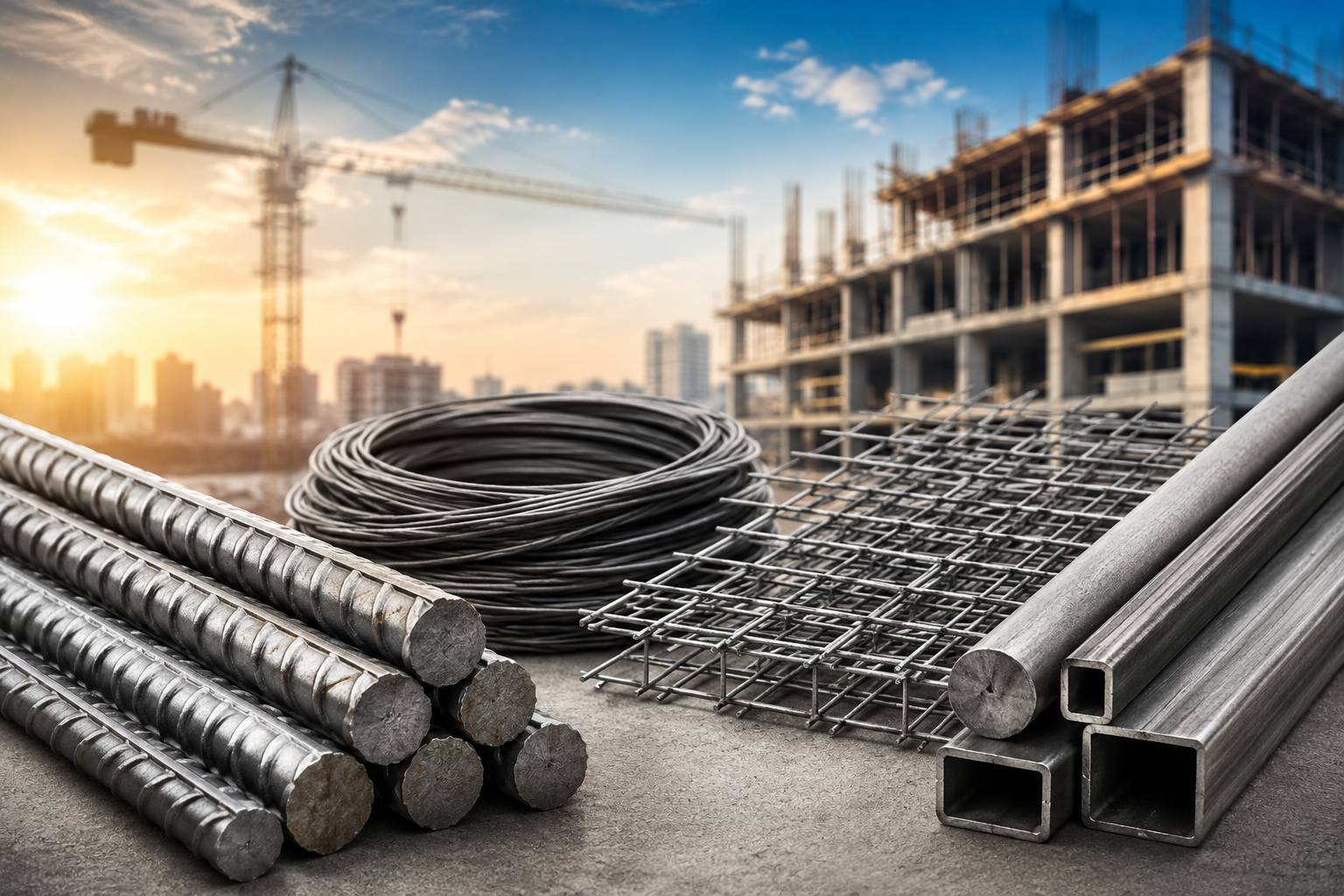
Common Reinforcing Materials Used in Construction
1. TMT Bars
Most widely used reinforcement material today.
Key Benefits
-
High tensile strength
-
Excellent ductility
-
Earthquake resistance
-
Corrosion resistance
-
Better concrete bonding
2. Mild Steel Bars
Traditional reinforcement material.
Advantages
-
Easy to bend
-
Lower initial cost
Limitations
-
Lower strength
-
Higher corrosion risk
-
Reduced durability
3. HYSD Bars
High Yield Strength Deformed bars were widely used before TMT technology became common.
Advantages
-
Better strength than mild steel
Limitations
-
Lower ductility than TMT bars
-
Reduced seismic performance
4. Welded Wire Mesh
Prefabricated steel mesh used in slabs and pavements.
Advantages
-
Faster installation
-
Uniform reinforcement
Limitations
-
Not suitable as primary reinforcement for heavy structures
5. Fiber Reinforcement Systems
Synthetic or steel fibers mixed directly into concrete.
Advantages
-
Crack control
-
Reduced shrinkage
Limitations
-
Cannot replace primary reinforcement steel
TMT Bars vs Other Reinforcing Materials
Strength Comparison
|
Material |
Strength |
|
TMT Bars |
Excellent |
|
Mild Steel |
Moderate |
|
HYSD Bars |
Good |
|
Welded Mesh |
Moderate |
|
Fiber Reinforcement |
Supplemental Only |
Winner: TMT Bars
TMT bars offer the highest combination of yield strength and ductility.
Modern TMT bars derive their strength from advanced thermo-mechanical treatment technology.
Corrosion Resistance Comparison
|
Material |
Corrosion Resistance |
|
TMT Bars |
Excellent |
|
Mild Steel |
Low |
|
HYSD Bars |
Moderate |
|
Welded Mesh |
Moderate |
|
Fiber Reinforcement |
High (non-metallic types) |
Winner: TMT Bars
Premium TMT bars provide excellent corrosion resistance, especially in humid and industrial environments.
Earthquake Resistance Comparison
|
Material |
Seismic Performance |
|
TMT Bars |
Excellent |
|
Mild Steel |
Moderate |
|
HYSD Bars |
Good |
|
Welded Mesh |
Limited |
|
Fiber Reinforcement |
Supplemental |
Winner: TMT Bars
High ductility allows TMT bars to absorb seismic forces without sudden failure.
Durability Comparison
|
Material |
Expected Durability |
|
TMT Bars |
Very High |
|
Mild Steel |
Moderate |
|
HYSD Bars |
High |
|
Welded Mesh |
Moderate |
|
Fiber Reinforcement |
Supplemental |
Winner: TMT Bars
Properly manufactured TMT bars can provide decades of structural performance.
Different grades offer varying levels of durability and load-bearing capacity.
Learn More : TMT Bar Essential Guide to Types and Benefit
Cost Comparison: Initial Cost vs Lifecycle Cost
One of the most common misconceptions is that the cheapest reinforcement material provides the best value.
In reality, the lifecycle cost matters more than initial purchase price.
|
Material |
Initial Cost |
Maintenance Cost |
Lifecycle Value |
|
TMT Bars |
Moderate |
Low |
Excellent |
|
Mild Steel |
Low |
High |
Moderate |
|
HYSD Bars |
Moderate |
Moderate |
Good |
|
Welded Mesh |
Moderate |
Moderate |
Good |
|
Fiber Reinforcement |
High |
Low |
Specialized Use |
Key Insight
TMT bars often provide the lowest overall cost over a building’s lifespan due to reduced maintenance and superior durability.
If you’re evaluating reinforcement options for a commercial project, this video explains the differences between TMT bars, traditional steel reinforcement, and alternative reinforcing materials, along with their impact on construction costs and long-term durability.
“Builders should evaluate both initial cost and lifecycle value when selecting reinforcement steel.”
Why Commercial Builders Prefer TMT Bars
Commercial construction projects require reinforcement materials that can withstand:
-
Heavy loads
-
Continuous usage
-
Environmental exposure
-
Structural movement
-
Long service life
TMT bars meet these requirements through:
High Load-Bearing Capacity
Suitable for:
-
Office buildings
-
Shopping complexes
-
Industrial plants
-
Hospitals
-
Educational institutions
Better Concrete Bonding
Ribbed surfaces improve structural integrity.
Reduced Maintenance
Corrosion resistance lowers repair and replacement costs.
Compliance with Standards
Quality TMT bars comply with IS 1786 standards.
“Commercial projects require reinforcement steel that meets stringent structural requirements.”
Best TMT Grades for Commercial Projects
|
Project Type |
Recommended Grade |
|
Commercial Buildings |
Fe 500D |
|
High-Rise Structures |
Fe 550 |
|
Industrial Facilities |
Fe 550D |
|
Infrastructure Projects |
Fe 550D |
|
Seismic Zones |
Fe 550D |
Why TMT Bars Are a Sustainable Construction Choice
Modern construction increasingly prioritizes sustainability.
TMT bars support sustainable construction by:
-
Reducing material wastage
-
Extending building lifespan
-
Improving resource efficiency
-
Lowering maintenance requirements
-
Supporting recyclable steel usage
These benefits align with green building practices and long-term infrastructure goals.
“Integrated steel manufacturing plays an important role in producing durable reinforcement materials.”
Why Ambashakti TMT Bars Are Suitable for Commercial Projects
Ambashakti manufactures high-strength TMT bars designed for residential, commercial, and infrastructure construction.
Key Advantages
-
Advanced thermo-mechanical treatment technology
-
High tensile strength
-
Excellent ductility
-
Corrosion resistance
-
Strong concrete bonding
-
IS 1786 compliance
These qualities make Ambashakti TMT bars suitable for demanding commercial applications.
Conclusion
When comparing reinforcement materials for commercial construction, TMT bars consistently outperform traditional alternatives in terms of strength, durability, corrosion resistance, earthquake performance, and lifecycle cost.
While mild steel bars, HYSD bars, welded mesh, and fiber reinforcement systems each have specific applications, TMT bars remain the preferred reinforcement solution for most commercial projects due to their superior structural performance and long-term value.
For builders, contractors, engineers, and project owners, investing in high-quality TMT bars helps ensure safer structures, reduced maintenance costs, and greater durability over the life of the project.
Related Resources
FAQs
Why are TMT bars preferred over mild steel bars?
TMT bars offer higher strength, better ductility, improved corrosion resistance, and longer service life.
Are TMT bars more expensive than other reinforcement materials?
The initial cost may be slightly higher, but TMT bars typically provide better lifecycle value through reduced maintenance and longer durability.
Can welded wire mesh replace TMT bars?
Welded wire mesh is often used as supplementary reinforcement but cannot fully replace TMT bars in major structural elements.
Which TMT grade is best for commercial buildings?
Fe 500D and Fe 550D are commonly used in commercial construction due to their strength and ductility.
Are TMT bars suitable for earthquake-prone areas?
Yes. Their high ductility helps absorb seismic forces, making them ideal for earthquake-resistant structures.
Do TMT bars resist corrosion?
Premium TMT bars offer excellent resistance to corrosion and rust, improving structural lifespan.
What is the biggest advantage of TMT bars?
The combination of strength, durability, ductility, and cost-effectiveness makes TMT bars the preferred reinforcement material for modern commercial construction.