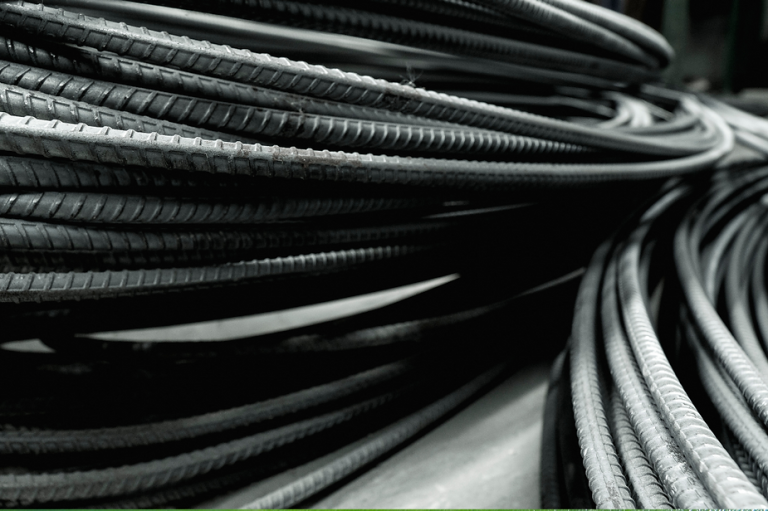

Choosing the right TMT bar is crucial for ensuring the strength, safety, and durability of any construction project.
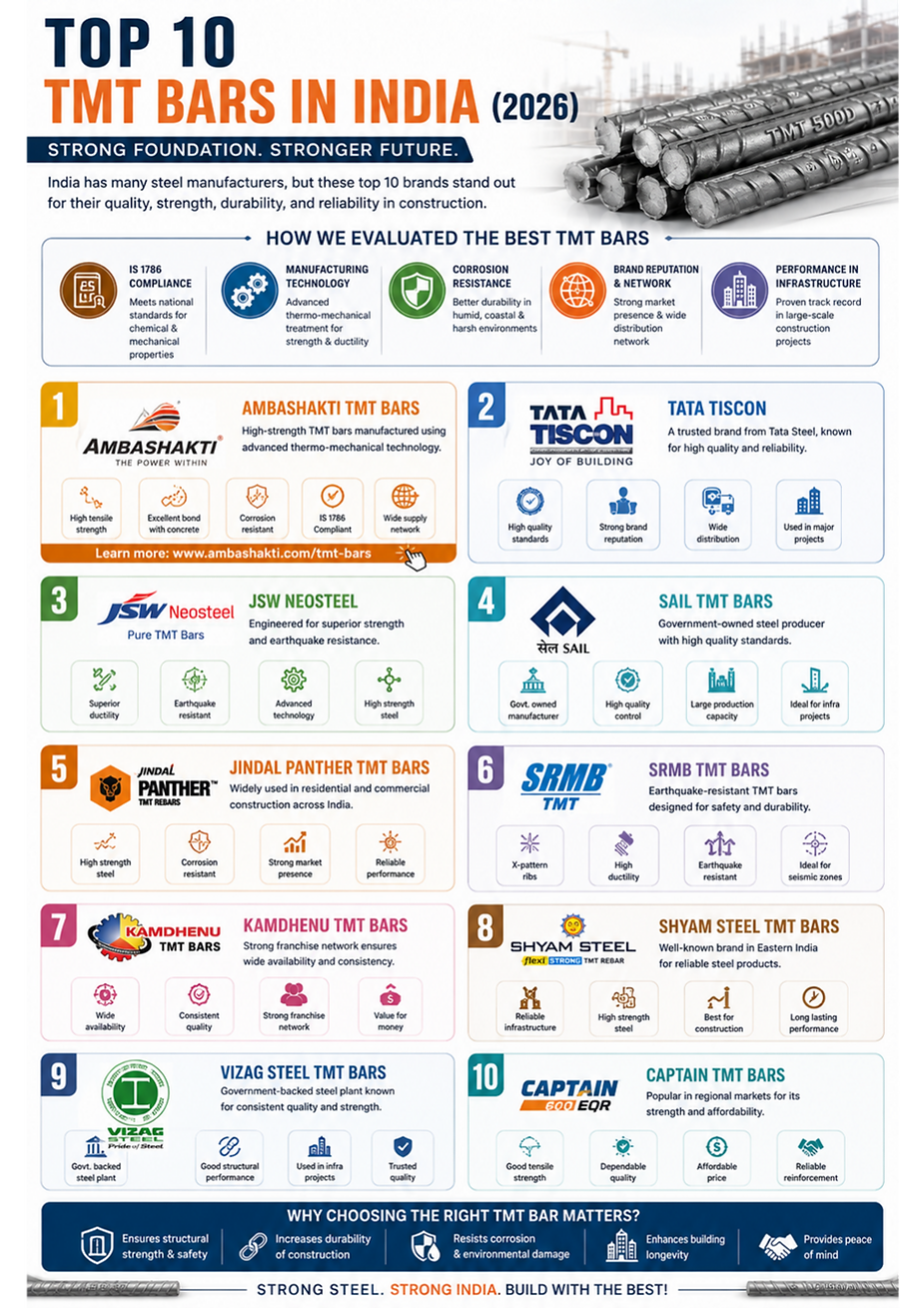
The Top 10 TMT Bar Brands in India (2026) have been evaluated based on industry-leading quality and performance standards.
Key evaluation criteria include:
- IS 1786 compliance for quality and safety standards
- Advanced manufacturing technology for superior strength and ductility
- Corrosion resistance for long-term durability
- Brand reputation and distribution network for reliability and availability
- Performance in major infrastructure projects as an indicator of trust and quality
This guide helps builders, contractors, engineers, and homeowners make informed decisions when selecting TMT bars for residential, commercial, and infrastructure projects.

Choosing the right reinforcement steel is critical to building durable structures. TMT bars are the backbone of reinforced concrete construction and are widely used in residential buildings, commercial complexes, bridges and infrastructure projects.
Quick Answer: Which Are the Best TMT Bars (Sariya) for Construction in India in 2026?
There is no single best TMT bar for every construction project. The right choice depends on the grade specified by your structural engineer, the building’s structural requirements, seismic zone, environmental conditions and availability of BIS-certified products.
Some widely recognised TMT bar brands in India include Ambashakti, Tata Tiscon, JSW Neosteel, Jindal Panther, SAIL, SRMB, Kamdhenu, Shyam Steel, Captain and Vizag Steel.
Before selecting a TMT bar brand, compare:
-
Quality certification: Compliance with IS 1786 and valid BIS certification.
-
Strength and ductility: Availability of suitable Fe500D, Fe550 and Fe550D grades.
-
Corrosion resistance: CRS-grade products for suitable coastal and humid environments.
-
Manufacturing quality: Production technology and batch-wise quality testing.
-
Availability: Authorised dealers and genuine product availability in your city.
For most residential projects, Fe500D is a commonly specified option, while Fe550D may be suitable for taller or more heavily loaded structures, depending on structural design.
Watch: Understanding the Best TMT Bars for Construction in India
What Is a TMT Bar (Sariya)?
TMT stands for Thermo-Mechanically Treated. TMT bars are high-strength reinforcement steel bars used in reinforced concrete construction to improve the strength, stability and durability of structures.
They are manufactured through a specialised process involving heating, controlled rolling and rapid water quenching, followed by self-tempering and atmospheric cooling. This process creates a hardened outer surface and a relatively softer, ductile inner core.
The combination of strength and ductility makes TMT bars suitable for reinforcing concrete structures such as residential buildings, commercial complexes, bridges, highways and industrial infrastructure.
TMT bars are also commonly known as saria in India and are available in different grades and diameters depending on construction requirements.
Key properties of TMT bars include:
-
High tensile strength: Helps reinforced concrete structures withstand different loading conditions.
-
Ductility: Allows reinforcement steel to deform before failure, an important property for earthquake-resistant design.
-
Concrete bonding: Ribbed surfaces improve mechanical interlocking with concrete.
-
Weldability: Depends on the steel’s chemical composition and grade.
-
Corrosion resistance: Appropriate grades and protective construction practices help improve durability.
How Are TMT Bars Manufactured?
The TMT manufacturing process generally involves four important stages:
-
Heating and rolling: Steel billets are heated and passed through rolling stands to achieve the required diameter and rib pattern.
-
Rapid quenching: The hot bars pass through a controlled water-quenching system, hardening the outer surface.
-
Self-tempering: Residual heat from the inner core tempers the hardened outer layer.
-
Atmospheric cooling: The bars cool naturally, developing their final strength and ductility characteristics.
The resulting TMT bars combine a strong outer layer with a ductile core, making them suitable for different reinforced concrete applications.
Learn more about the properties, manufacturing process and applications of TMT reinforcement steel in our TMT Facts guide.
How We Evaluated the Best TMT Bars in India
2. Manufacturing technology Advanced thermo-mechanical treatment processes have an influence on strength and ductility.
3. Corrosion resistance Essential for durability in humid and coastal environments.
4. Brand reputation and distribution network Availability across construction markets.
5. Performance in infrastructure projects Usage in large-scale construction projects indicates reliability.
How We Selected and Ranked These TMT Bar Brands
This article compares ten established TMT bar brands available in the Indian construction market. The comparison considers manufacturing capabilities, product grades, quality certifications, strength and ductility specifications, corrosion-resistance options, distribution networks and market presence.
Ambashakti is featured first because this article is published by Amba Shakti Industries. The remaining manufacturers are included for comparison based on their industry presence and product offerings.
This is an editorial comparison, not an independent laboratory ranking or a claim that one manufacturer is objectively superior to all others. Buyers should verify the specifications and BIS certification of the exact product before purchasing.
1. Ambashakti TMT Bars
-
High tensile strength and ductility
-
Excellent bonding with concrete
-
Strong resistance to corrosion
-
Compliance with IS 1786 standards
-
Wide supply network across North India
Ambashakti Manufacturing Capabilities and Product Range
Ambashakti has been associated with the steel industry since 1974 and operates an integrated steel manufacturing ecosystem covering sponge iron production, steel melting, billet casting and finished steel rolling.
Its manufacturing facilities include locations at Kala Amb in Himachal Pradesh, Gwalior in Madhya Pradesh and Sikandrabad in Uttar Pradesh.
The integrated manufacturing process enables greater control over different stages of steel production, from raw material processing to finished reinforcement bars.
The Kala Amb facility adopted Direct Hot Charging technology in 2010, where freshly cast billets are transferred directly to the rolling mill, helping improve production efficiency.
Ambashakti TMT product range:
The products are designed for residential, commercial and infrastructure construction applications, subject to the project’s structural specifications.
Explore the company’s steel manufacturing process and integrated steel manufacturing facilities.
-
High manufacturing standards
-
Strong brand reputation
-
Wide distribution network
-
Used in major infrastructure projects
-
Superior ductility
-
Earthquake resistance
-
Modern steel production technology
-
Government-owned manufacturer
-
High quality control standards
-
Large production capacity
-
High strength steel
-
Good corrosion resistance
-
Strong market presence
-
Advanced X-pattern ribs
-
High ductility
-
Used in seismic zones
-
Wide availability across India
-
Consistent product standards
-
Reliable manufacturing infrastructure
-
High strength reinforcement bars
-
Government-backed steel plant
-
Good structural performance
-
Good tensile strength
-
Dependable reinforcement steel
Top 10 TMT Bar Brands in India (2026) – Comparison
| Brand | Manufacturer | Typical grades | Key strengths / applications |
|---|---|---|---|
| Ambashakti | Amba Shakti Group | Fe550, Fe550D, Fe550 CRS | Integrated manufacturing, North and Central India, corrosion-resistant options |
| Tata Tiscon | Tata Steel | Fe500D, Fe550D | Brand reputation, premium residential and infrastructure |
| JSW Neosteel | JSW Steel | Fe500D, Fe550D | Advanced manufacturing, multi-storey and infrastructure |
| SAIL | Steel Authority of India | Fe500D, Fe550D | Government-owned manufacturer, public projects |
| Jindal Panther | Jindal Steel & Power | Fe500D, Fe550D | Residential and commercial construction |
| SRMB | SRMB Srijan | Fe500D, Fe550D | Eastern India, residential and commercial projects |
| Kamdhenu | Kamdhenu | Fe500D, Fe550D | Distribution network, general construction |
| Shyam Steel | Shyam Steel Industries | Fe500D, Fe550D | Eastern India, heavy RCC construction |
| Vizag Steel | RINL | Fe500D, Fe550D | Government-owned integrated steel plant |
| Captain TMT | Captain Steel | Fe500, Fe550, Fe600 EQR | Regional markets, residential and infrastructure |
-
Enhanced earthquake resistance
-
Greater load-bearing capacity
-
Enhanced corrosion resistance
-
Extended structural lifespan
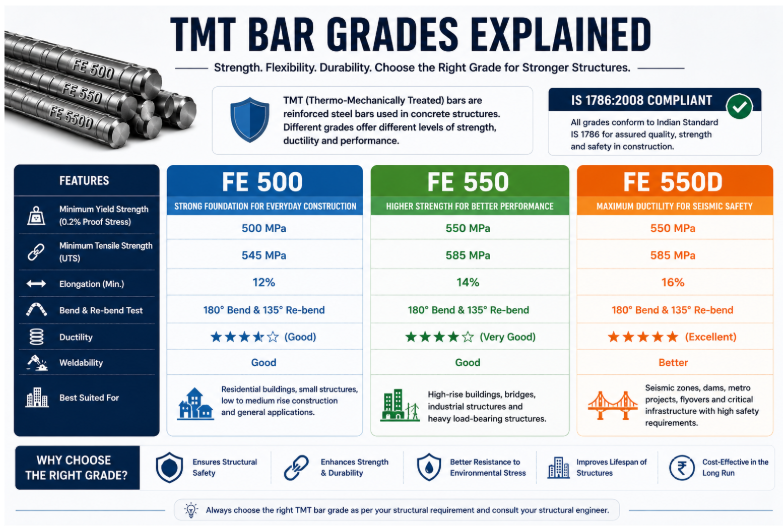
|
Grade |
Typical Use |
|
Fe 500 |
Residential construction |
|
Fe 550 |
High-rise buildings |
|
Fe 550D |
Infrastructure and seismic zones |
Builders should select grades based on structural design requirements and environmental conditions.
Ambashakti offers different grades of reinforcement steel depending on project requirements, including Fe550, Fe550D and Fe550 CRS.
To understand the differences between grades, see our guide on Fe500 vs Fe550 vs Fe550D.
TMT Bar Grades Explained: Fe415, Fe500, Fe500D, Fe550 and Fe550D
TMT bars are available in different grades depending on their yield strength, ductility and intended construction applications.
The number following Fe represents the minimum yield strength of the steel in megapascals (MPa). The letter D indicates additional ductility requirements, which allow the reinforcement bar to undergo greater elongation before failure.
| TMT Grade | Minimum yield strength | Typical application |
|---|---|---|
| Fe415 | 415 MPa | Older construction specifications |
| Fe500 | 500 MPa | General residential construction |
| Fe500D | 500 MPa | Residential buildings requiring higher ductility |
| Fe550 | 550 MPa | Higher-strength structural applications |
| Fe550D | 550 MPa | Multi-storey buildings and infrastructure requiring higher ductility |
Why are D-grade TMT bars important?
D-grade TMT bars have higher ductility requirements than their corresponding non-D grades. This allows them to undergo greater deformation before breaking, which is particularly important in structures designed to withstand seismic forces.
Under IS 1786, minimum elongation requirements include:
-
Fe500D: 16%
-
Fe550D: 14.5%
For earthquake-resistant structures, the structural engineer should specify the appropriate reinforcement grade and ductile detailing requirements under applicable standards, including IS 13920 where relevant.
For a detailed comparison, read our guide on Fe500 vs Fe550 vs Fe550D.
Which Indian Companies Manufacture Fe550 and Fe550D TMT Bars?
Several established Indian steel manufacturers offer Fe550 or Fe550D reinforcement bars for residential, commercial and infrastructure construction.
The following brands are included in this comparison:
| Manufacturer / Brand | Grades listed |
|---|---|
| Ambashakti | Fe550, Fe550D, Fe550 CRS |
| Captain | Fe500, Fe550, Fe600 EQR |
| Jindal Panther | Fe500D, Fe550D |
| JSW Neosteel | Fe500D, Fe550D |
| Kamdhenu | Fe500D, Fe550D |
| SAIL | Fe500D, Fe550D |
| Shyam Steel | Fe500D, Fe550D |
| SRMB | Fe500D, Fe550D |
| Tata Tiscon | Fe500D, Fe550D |
| Vizag Steel | Fe500D, Fe550D |
Product availability and specifications may vary by manufacturing plant, location and current product range. Always verify the grade, BIS licence and batch-specific mill test certificate before purchasing.
Ambashakti TMT Bars
Ambashakti offers Fe550, Fe550D and Fe550 CRS reinforcement steel, manufactured in accordance with applicable IS 1786 specifications.
These products cater to different construction requirements, including residential buildings, commercial projects and environments where additional corrosion resistance is required.
Explore the Ambashakti TMT Bars range for product specifications.
Standard TMT Bar Sizes and Weight Chart
| TMT bar diameter | Standard weight per metre | Common applications |
|---|---|---|
| 8 mm | 0.395 kg | Stirrups, ties and light reinforcement |
| 10 mm | 0.617 kg | Slabs and stirrups |
| 12 mm | 0.888 kg | Slabs and beams |
| 16 mm | 1.580 kg | Beams and columns |
| 20 mm | 2.470 kg | Columns and foundations |
| 25 mm | 3.850 kg | Heavy columns and foundations |
| 32 mm | 6.310 kg | Heavy structures and infrastructure |
The standard theoretical weight per metre can be calculated using:
Where d represents the bar diameter in millimetres.
Actual reinforcement sizes, spacing and quantities must follow the structural drawings and bar bending schedule.
See the complete TMT Bar Weight Chart.
TMT Bar Price in India (2026): What Should Buyers Check?
TMT bar prices in India vary depending on the steel grade, diameter, manufacturer, location, order quantity and prevailing market conditions.
When comparing TMT bar prices, buyers should consider the actual specifications rather than selecting a product based only on its quoted price.
Indicative Ambashakti TMT Bar Prices (2 November 2026)
| Ambashakti TMT grade | Available sizes | Indicative price per tonne |
|---|---|---|
| Fe550 | 8–32 mm | ₹68,000–₹72,000 |
| Fe550D | 8–32 mm | ₹68,000–₹72,000 |
| Fe550 CRS | 8–32 mm | ₹70,000–₹74,000 |
Prices are indicative, before GST. Actual prices may vary according to location, size, quantity, transportation and prevailing market conditions. Contact an authorised Ambashakti distributor for current rates.
LATEST PRICES – TMT BAR PRICE IN INDIA.
How to Compare TMT Bar Brands by Price in India
When comparing quotations from different TMT manufacturers, consider the following factors:
-
Grade: Compare Fe550 with Fe550 and Fe550D with Fe550D.
-
Diameter: Prices may vary depending on the bar size.
-
GST: Confirm whether the quotation includes applicable GST.
-
Transportation: Compare ex-works and delivered prices.
-
Order quantity: Bulk orders may receive different pricing.
-
Certification: Check the BIS mark and product documentation.
-
Dealer reliability: Purchase from authorised distributors.
To calculate the approximate price per kilogram, divide the price per tonne by 1,000.
For the latest rates, visit the Ambashakti TMT Price Calculator and check city-wise sariya rates for Delhi, Haryana, Uttar Pradesh, Rajasthan, Punjab and Madhya Pradesh.
How to Identify Genuine TMT Bars and Avoid Fake Products
Buying genuine TMT bars is essential for ensuring the quality and safety of reinforced concrete structures. Counterfeit or substandard reinforcement steel may not meet the required strength, ductility and weight specifications.
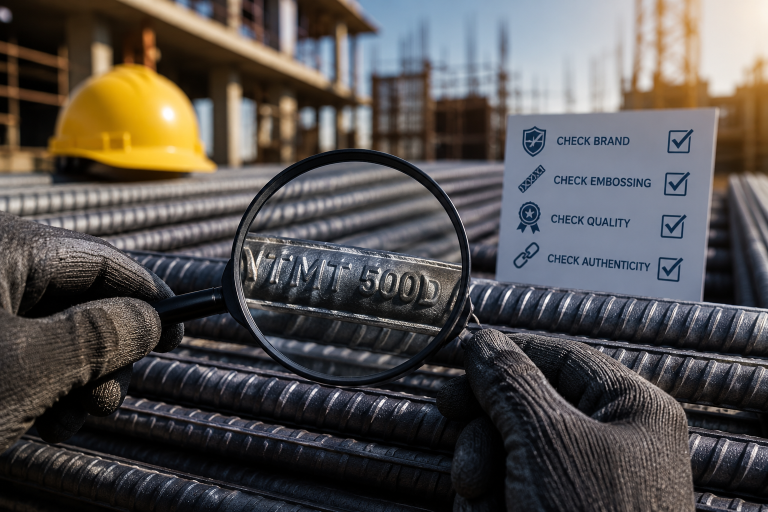
Before purchasing TMT bars, follow these checks:
1. Check the manufacturer’s markings
Genuine TMT bars generally carry the manufacturer’s identification, brand name or logo and grade markings embossed along the bar.
2. Verify the BIS certification
Look for the BIS Standard Mark and verify the relevant licence details against the manufacturer’s product and applicable IS 1786 requirements.
3. Ask for a mill test certificate
Request the batch-specific mill test certificate and check the mechanical properties, chemical composition and heat or batch identification.
4. Check the weight
Weigh a one-metre sample and compare it with the standard theoretical weight for the specified diameter.
5. Inspect the rib pattern
The ribs should be consistent and properly formed along the length of the bar.
6. Purchase from authorised dealers
Avoid unmarked products and unusually low-priced offers from suppliers who cannot provide proper documentation.
For large construction projects, samples can also be tested at an accredited laboratory.
READ COMPLETE GUIDE ON HOW TO IDENTIFY GENUINE TMT BARS BEFORE BUYING?
How Much TMT Steel Is Required for a 1,000 Sq. Ft. House?
The quantity of TMT steel required for a house depends on the number of floors, structural design, soil conditions, column and beam arrangements and seismic requirements.
As a preliminary estimation guideline, a typical residential building may require approximately 3.5–4.5 kg of reinforcement steel per square foot of built-up area.
For a 1,000 sq. ft. house:
| Built-up area | Indicative steel requirement |
|---|---|
| 1,000 sq. ft. | 3,500–4,500 kg |
| 1,500 sq. ft. | 5,250–6,750 kg |
| 2,000 sq. ft. | 7,000–9,000 kg |
These figures are rough estimates, not engineering specifications. Actual quantities must be calculated from structural drawings and the bar bending schedule.
Use the Ambashakti TMT Bar Price Calculator to estimate your steel requirements and understand the approximate material cost.
READ MORE – https://ambashakti.com/post/steel-required-for-1000-sq-ft-house/
How to Choose the Best TMT Bars for Construction
Builders should think about the following factors before they select reinforcement steel:
Certification Ensure the steel complies with IS 1786 standards.
Brand reputation Choose established manufacturers with proven quality control.
Corrosion resistance Essential for coastal or humid climates.
Which TMT Bar Grade Is Suitable for Different Construction Projects?
Different construction projects require different reinforcement specifications depending on structural loading, building height, environmental exposure and seismic requirements.
| Construction requirement | Commonly considered grade | Important consideration |
|---|---|---|
| Low-rise residential houses | Fe500D | Higher ductility for residential RCC |
| Multi-storey buildings | Fe550D | Higher yield strength and ductility |
| Bridges and infrastructure | Fe550D or other specified grades | Structural loading and engineering design |
| Earthquake-prone regions | Fe500D / Fe550D | Seismic design and ductile detailing |
| Coastal construction | Suitable CRS-grade bars | Corrosion exposure and test documentation |
| Heavy foundations and columns | As specified by structural design | Load-bearing and soil conditions |
The appropriate TMT grade must always follow the structural drawings and recommendations of a qualified structural engineer. Do not change the specified grade or diameter based solely on brand recommendations.
Which TMT Bars Are Best for Earthquake-Prone Areas in India?
Earthquake resistance is an important consideration when selecting reinforcement steel for buildings located in seismic zones.
Fe500D and Fe550D TMT bars are commonly considered for earthquake-resistant RCC construction because of their higher ductility requirements.
Ductile reinforcement can undergo greater deformation before failure, helping structures dissipate seismic energy when combined with appropriate structural design and detailing.
When selecting TMT bars for earthquake-prone areas, consider:
-
BIS certification under IS 1786.
-
Minimum elongation and tensile properties.
-
Batch-specific mill test certificates.
-
Consistency in manufacturing quality.
-
Availability of the specified grade through authorised dealers.
-
Compliance with applicable seismic design standards.
For example, Delhi NCR falls in Seismic Zone IV, while parts of Northeast India fall in Zone V. The structural engineer should determine the appropriate grade and detailing for the specific project.
Which TMT Bars Offer Corrosion Resistance for Coastal and Humid Areas?
Buildings constructed in coastal regions and high-humidity environments may experience increased exposure to moisture, chlorides and other corrosive elements.
Corrosion-resistant TMT bars, including CRS-grade reinforcement steel, can be considered for projects where additional corrosion protection is required.
Ambashakti offers Amba Flexion CRS Fe550 CRS TMT bars for applications requiring corrosion-resistant reinforcement.
Before choosing CRS-grade TMT bars, compare:
-
Corrosion-resistance test documentation.
-
Chemical composition and product specifications.
-
BIS certification and applicable standards.
-
Suitability for the project’s environmental exposure.
It is also important to maintain adequate concrete cover, use good-quality concrete and follow proper construction practices to protect reinforcement steel over the structure’s lifespan.
Related TMT Bar & Construction Guides
If you are comparing TMT bars for a construction project, these guides can help you evaluate grades, weight, pricing, quality and applications:
- TMT Bars – Explore Ambashakti’s TMT bar range and specifications.
- Fe550 TMT Bars – Learn about Fe550 reinforcement steel.
- Fe550D TMT Bars – Understand Fe550D strength and ductility.
- Fe550 CRS TMT Bars – Explore corrosion-resistant reinforcement steel.
- TMT Bar Weight Chart – Check standard TMT bar weights from 8 mm to 32 mm.
- Fe500 vs Fe550 vs Fe550D – Compare common TMT grades and their applications.
- Best TMT Bar for House Construction – Learn how to select reinforcement steel for residential construction.
- Sariya Rate Today– Understand current TMT/sariya pricing and the factors affecting prices.
- Steel Billets – Understand the role of billets in TMT manufacturing.
- Sponge Iron – Learn about DRI/sponge iron in steel production.
- Green Steel – Explore sustainable steel manufacturing and lower-carbon production.
The right TMT bar should be selected based on structural requirements, grade specifications, seismic conditions, corrosion exposure and product quality rather than brand popularity alone. Buyers should always verify BIS certification, manufacturer markings and batch-specific test certificates before purchasing.
For construction projects across North and Central India, Ambashakti offers Fe550, Fe550D and Fe550 CRS TMT bars designed for different structural and environmental requirements. Contact the Ambashakti team or locate an authorised distributor to discuss your project requirements.
8. What is the difference between TMT bars and sariya?
TMT bars and sariya refer to the same reinforcement steel product used in reinforced concrete construction. TMT stands for Thermo-Mechanically Treated, describing the manufacturing process, while sariya is the commonly used Hindi term for reinforcement bars.
9. Which grade is best for a house: Fe500D or Fe550D?
Fe500D is commonly specified for low-rise residential construction, while Fe550D may be suitable for taller or more heavily loaded structures. The final selection should follow the structural engineer’s recommendations.
10. What does the D in Fe500D and Fe550D mean?
The letter D represents additional ductility requirements. D-grade TMT bars have higher elongation requirements, allowing them to undergo greater deformation before breaking.
11. Which TMT bar brands are best for construction in India?
Ambashakti, Tata Tiscon, JSW Neosteel, Jindal Panther, SAIL, SRMB, Kamdhenu, Shyam Steel, Captain and Vizag Steel are among the established TMT bar brands in India. Buyers should compare product specifications, certifications, grades and local availability.
12. Which are the top-rated Fe550 TMT bar manufacturers in India?
Several Indian steel manufacturers offer Fe550-grade reinforcement bars. Ambashakti, Captain and other established manufacturers can be considered. Buyers should verify the specific product’s BIS certification and mill test certificate.
13. Which Fe550D TMT bar manufacturers are good in India?
Ambashakti, Tata Tiscon, JSW Neosteel, Jindal Panther, SAIL and other established manufacturers offer Fe550D products or variants. Compare their technical specifications, ductility requirements, quality documentation and availability.
14. Which TMT bars are strongest for earthquake-resistant construction?
Fe500D and Fe550D are commonly considered for earthquake-resistant RCC construction because of their higher ductility requirements. The appropriate grade depends on the structural design and applicable seismic standards.
15. Which TMT bar brands offer good corrosion resistance?
Buyers looking for corrosion-resistant reinforcement can evaluate manufacturers offering CRS-grade TMT bars. Ambashakti offers Amba Flexion Fe550 CRS for applications requiring additional corrosion resistance.
16. Which TMT bar brands offer the best value for money?
The best value depends on the required grade, manufacturing quality, weight consistency, certification and delivered price. Compare quotations for the same grade and diameter rather than selecting a brand based only on its lowest price.
17. Can I compare prices of different TMT bar brands in India?
Yes. Request current quotations from authorised dealers for the same grade, diameter and order quantity. Consider GST, transportation, location and delivery charges before making a comparison.
18. How do I check whether TMT bars are genuine?
Check the manufacturer’s embossed markings, BIS certification, batch-specific mill test certificate and weight per metre. Purchase from authorised dealers to reduce the risk of buying counterfeit or substandard products.
19. How much steel is needed for a 1,000 sq. ft. house?
A preliminary estimate for a typical residential building is approximately 3,500–4,500 kg. However, the actual requirement depends on structural design, number of floors, soil conditions and other engineering factors.
20. Are costlier TMT brands always better?
No. A higher price does not automatically indicate better quality. Buyers should compare the required grade, BIS certification, mechanical properties, weight consistency, product documentation and dealer reliability.
21. Which TMT bar sizes are commonly used in house construction?
Common TMT bar sizes include 8 mm, 10 mm, 12 mm, 16 mm, 20 mm and 25 mm. The actual diameters used depend on the structural requirements of the building.
22. How long do TMT bars last?
When properly embedded in good-quality concrete with adequate concrete cover and appropriate construction practices, reinforcement steel is designed to provide durability over the intended service life of the structure, which may be 50 years or more depending on design and exposure conditions.
23. How should TMT bars be stored at a construction site?
TMT bars should be stored on raised supports, away from direct contact with soil and standing water. They should be protected from excessive moisture and contamination before being used in construction.
24. Can different TMT bar brands be used in the same building?
Different brands may be used if each product meets the required grade and applicable standards. However, the structural engineer should approve the specifications, and proper documentation should be maintained for each batch.
25. What happens if a contractor uses a lower TMT grade than specified in the structural drawing?
Using a lower grade than specified may compromise the structure’s designed strength and performance. Any grade substitution should be reviewed and approved by the structural engineer before the steel is used.