
Top 10 Steel Brands in India 2026 for Construction
Choosing the right steel brand is one of the most important decisions when planning a construction project. Whether you are building an individual house, a residential apartment, a commercial complex, a factory or infrastructure, the quality of steel directly influences structural performance, durability and long-term reliability.
India has a diverse steel manufacturing industry, with established companies producing TMT reinforcement bars, steel billets, structural sections, plates, coils and other steel products. These manufacturers serve different requirements across residential construction, infrastructure, engineering and industrial applications.
However, selecting the best steel brand is not simply about choosing the most recognised company. Buyers should consider manufacturing capabilities, product specifications, applicable BIS standards, mechanical properties, quality testing, product availability and project requirements.
In this guide, we explore the top 10 steel brands and manufacturers in India in 2026, their major product categories and what construction buyers should consider before selecting steel.
Editorial disclosure: This is an informational comparison of selected Indian steel manufacturers and brands, not an independent laboratory assessment or a verified ranking by production capacity, sales or market share. Ambashakti is included as the publisher’s own brand. The order is editorial and should not be interpreted as a ranking of product quality.
Quick Answer: Top 10 Steel Brands in India 2026
Some of the notable steel manufacturers and brands serving India’s construction and infrastructure sectors include:
- Ambashakti
- Tata Steel
- JSW Steel
- Steel Authority of India Limited (SAIL)
- Jindal Steel & Power
- AM/NS India
- RINL – Vizag Steel
- Shyam Steel
- SRMB
- Rungta Steel
These companies operate across different segments of the steel industry. While some manufacture a broad range of integrated steel products, others have a stronger focus on reinforcement bars and construction-related steel.
The right choice depends on the particular product, grade, technical specification, location and intended application.
Overview of the Indian Steel Industry in 2026
India is one of the world’s leading steel-producing countries. Its steel industry supports residential and commercial construction, roads, bridges, railways, industrial facilities, manufacturing and major infrastructure projects.
According to the Ministry of Steel’s Annual Report 2025–26, India produced approximately 152.18 million tonnes of crude steel during FY 2024–25. Domestic crude steel capacity reached approximately 218.45 million tonnes per annum by December 2025, according to provisional figures.
The report also recorded finished steel consumption of approximately 119.57 million tonnes during April–December 2025–26.
These figures demonstrate the scale of India’s steel industry and the importance of reliable manufacturing and supply networks.
The industry includes:
- Integrated steel manufacturers.
- Secondary steel producers.
- TMT reinforcement manufacturers.
- Structural steel manufacturers.
- Sponge iron and billet producers.
- Speciality and alloy steel manufacturers.
For construction buyers, understanding the difference between these manufacturers and their product categories is essential.
What Is Construction Steel?
Construction steel refers to different steel products used in buildings, infrastructure and structural applications.
The major categories include:
1. TMT Reinforcement Bars
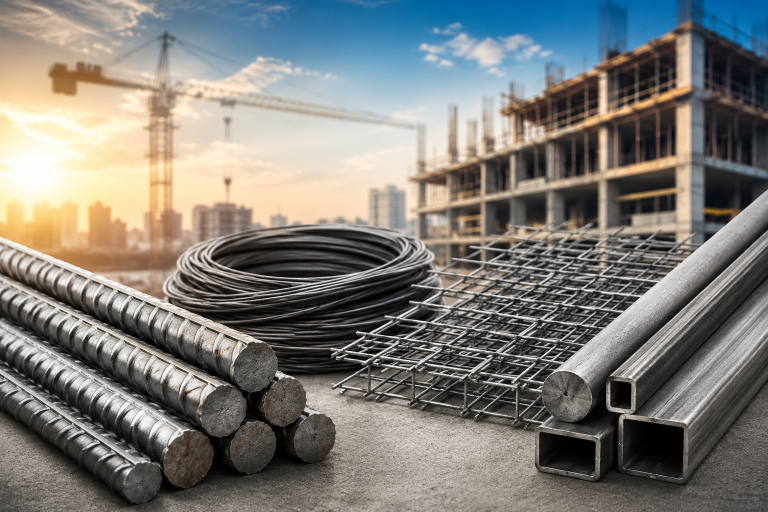
Thermo-Mechanically Treated (TMT) bars are used to reinforce concrete structures. They help concrete members withstand tensile stresses and are commonly used in foundations, columns, beams, slabs and other RCC components.
2. Structural Steel
Structural steel includes angles, channels, beams, sections and plates. These products are used in structural frameworks, fabrication, industrial buildings and infrastructure.
3. Steel Billets
Billets are semi-finished steel products used as raw material for manufacturing TMT bars, wire rods, angles and other rolled steel products.
4. Sponge Iron
Sponge iron, also known as Direct Reduced Iron (DRI), is an intermediate iron product used in steelmaking.
5. Steel Plates and Coils
These products are used in fabrication, engineering, automotive manufacturing, infrastructure and industrial applications.
A manufacturer should be evaluated according to the product category required for the project rather than its overall brand reputation alone.
How to Identify the Best Steel Manufacturers in India
Before comparing steel companies, it is important to understand the factors that influence product quality and manufacturing reliability.
1. Manufacturing Capacity and Infrastructure
Manufacturing capacity indicates the scale of a company’s production operations and its ability to serve different customer requirements.
Buyers should consider the manufacturer’s production facilities, available technology, product portfolio and ability to supply the required quantity.
2. Product Portfolio
A manufacturer offering different steel products can serve multiple construction and industrial requirements.
For example, its portfolio may include TMT bars, steel billets, sponge iron, angles, channels and other structural products.
3. Manufacturing Technology
Modern steel manufacturing involves several controlled processes, including steelmaking, billet casting, reheating, rolling and cooling.
Consistent process control helps manufacturers maintain the required dimensions, chemical composition and mechanical properties.
4. Quality Standards and Certifications
Check the applicable BIS standards and product certifications for the specific steel product.
For TMT reinforcement bars, IS 1786 specifies requirements for high-strength deformed steel bars and wires for concrete reinforcement.
Buyers should also check relevant quality management certifications and testing documentation.
5. Mechanical Properties
For TMT bars, important mechanical properties include:
- Yield strength.
- Tensile strength.
- Percentage elongation.
- Bend and rebend performance.
- Chemical composition.
These properties should be evaluated against the applicable grade and project requirements.
6. Distribution and Availability
A good manufacturer should have an effective supply network for delivering the required steel products.
Regional availability, authorised dealers, transportation costs and delivery timelines can influence the final procurement decision.
7. Sustainability and Environmental Management
Steel manufacturing involves significant energy and raw-material requirements.
Manufacturers are increasingly focusing on scrap recycling, energy recovery, efficient production methods and environmental management.
These initiatives are becoming important considerations for infrastructure developers and construction buyers.
Top 10 Steel Brands in India 2026 – Detailed Company Profiles
1. Ambashakti
Ambashakti is an Indian steel manufacturer with a diversified product portfolio covering TMT reinforcement bars, steel billets, sponge iron and structural steel products.
The company has been associated with the steel industry since 1974 and operates an integrated manufacturing ecosystem connecting different stages of steel production.
Its manufacturing approach covers raw-material processing, sponge iron production, steelmaking, billet manufacturing and rolling.
Major steel products offered by Ambashakti:
- TMT Bars.
- FE550 – Amba Shakti SD.
- FE550D – Amba Flexion.
- FE550 CRS – Amba Flexion CRS.
- Steel Billets.
- Sponge Iron.
- Steel Angles and Channels.
TMT Bar Grades
Ambashakti’s TMT portfolio includes FE550, FE550D and FE550 CRS grades, with product sizes ranging from 8 mm to 40 mm.
Each grade serves different reinforcement requirements:
- FE550: High-strength reinforcement with a specified minimum yield strength of 550 MPa.
- FE550D: High-strength reinforcement with enhanced ductility requirements.
- FE550 CRS: Corrosion-resistant reinforcement for applications where environmental exposure and corrosion requirements need additional consideration.
The company’s product information states compliance with IS 1786, ISO 9001:2015 quality management and third-party testing through NABL-accredited facilities.
Why consider Ambashakti?
- Integrated steel manufacturing operations.
- Multiple construction-related steel products.
- TMT reinforcement grades for different project specifications.
- Steel billet manufacturing.
- Structural products such as angles and channels.
- Quality testing and product documentation.
Ambashakti’s product portfolio serves residential, commercial and infrastructure-related construction requirements.
For detailed product specifications, explore Ambashakti TMT Bars.
You can also learn about its Steel Billets and Angles & Channels for structural applications.
2. Tata Steel
Tata Steel is one of India’s major integrated steel manufacturers, with operations serving construction, automotive, engineering, infrastructure and industrial markets.
Established in 1907, the company has a long history in the Indian steel industry and operates manufacturing facilities in India and other countries.
Its product portfolio includes different categories of long and flat steel products, catering to varied industrial and construction requirements.
Major product categories include:
- TMT reinforcement bars.
- Hot-rolled steel.
- Cold-rolled steel.
- Galvanised steel.
- Structural steel.
- Wire rods.
- Speciality steel products.
Tata Tiscon is its well-known reinforcement steel brand, serving residential, commercial and infrastructure construction markets.
Why consider Tata Steel?
- Established steel manufacturing operations.
- Diversified product portfolio.
- Presence across multiple steel market segments.
- Construction and infrastructure-related product offerings.
- Established distribution and customer network.
For construction projects, buyers should compare the exact TMT grade, product specifications and applicable certification before purchasing.
3. JSW Steel
JSW Steel is one of India’s major private-sector integrated steel producers.
The company operates across steelmaking and downstream manufacturing, supplying steel products for infrastructure, construction, automotive, engineering and other industrial applications.
Its manufacturing operations include steel production and processing facilities designed to serve different market requirements.
Major product categories include:
- TMT reinforcement bars.
- Hot-rolled steel.
- Cold-rolled steel.
- Galvanised and coated steel.
- Wire rods.
- Speciality steel products.
JSW Neosteel is its construction reinforcement steel offering.
The brand is associated with TMT products used in residential, commercial and infrastructure construction.
Why consider JSW Steel?
- Large-scale steel manufacturing operations.
- Diversified steel product portfolio.
- Presence in construction and infrastructure markets.
- Downstream processing capabilities.
- Established distribution network.
When selecting its reinforcement products, check the exact grade, dimensions, mechanical properties and certification required by the structural design.
4. Steel Authority of India Limited (SAIL)
Steel Authority of India Limited (SAIL) is one of India’s largest public-sector steel manufacturers.
The company operates integrated steel plants and supplies steel products for infrastructure, construction, engineering, railways and industrial applications.
SAIL has played an important role in India’s steel development and continues to serve major public and private sector requirements.
Major product categories include:
- TMT reinforcement bars.
- Structural steel.
- Rails.
- Plates.
- Hot-rolled products.
- Wire rods.
- Special steel products.
SAIL TMT reinforcement products are used in different construction and infrastructure applications.
Why consider SAIL?
- Public-sector integrated steel manufacturing.
- Established manufacturing infrastructure.
- Diverse steel product portfolio.
- Products serving infrastructure and construction.
- Long-standing presence in the Indian steel industry.
Buyers should verify the exact product grade, applicable standard, dimensions and availability before procurement.
5. Jindal Steel & Power
Jindal Steel & Power (JSPL) is a major Indian steel and energy company with operations serving construction, infrastructure, manufacturing and industrial markets.
The company manufactures different categories of steel products and operates steel production facilities with integrated manufacturing capabilities.
Its steel business includes long and flat steel products, catering to a wide range of applications.
Major product categories include:
- TMT reinforcement bars.
- Structural steel.
- Rails.
- Plates.
- Wire rods.
- Other steel products.
Jindal Panther is among the company’s recognised construction steel brands.
Its reinforcement steel products serve residential, commercial and infrastructure requirements.
Why consider Jindal Steel & Power?
- Integrated steel manufacturing.
- Construction and infrastructure product portfolio.
- Structural steel offerings.
- Manufacturing and processing capabilities.
- Established presence in the Indian steel market.
Before choosing a product, compare the required grade, technical specifications, testing documents and supply availability.
6. AM/NS India
ArcelorMittal Nippon Steel India (AM/NS India) is an integrated steel manufacturer established through the partnership between ArcelorMittal and Nippon Steel.
The company serves several industries, including construction, automotive, infrastructure, engineering and manufacturing.
Its manufacturing operations include steelmaking, processing and downstream product manufacturing.
Major product categories include:
- Hot-rolled steel.
- Cold-rolled steel.
- Galvanised steel.
- Colour-coated steel.
- Plates.
- Other value-added steel products.
The company has a significant presence in India’s flat steel segment.
Why consider AM/NS India?
- Integrated steel manufacturing operations.
- Broad range of flat steel products.
- International manufacturing and technology experience.
- Products serving infrastructure and industrial markets.
- Downstream steel processing capabilities.
Construction buyers should identify the exact steel product required before comparing it with other reinforcement or structural steel manufacturers.
7. RINL – Vizag Steel
Rashtriya Ispat Nigam Limited (RINL), commonly known as Vizag Steel, operates the Visakhapatnam Steel Plant in Andhra Pradesh.
It is a public-sector steel producer with a product portfolio serving construction, infrastructure and industrial applications.
The company has traditionally been associated with long steel products used in different engineering and construction requirements.
Major product categories include:
- TMT reinforcement bars.
- Wire rods.
- Structural steel.
- Other long steel products.
Why consider RINL – Vizag Steel?
- Integrated steel manufacturing operations.
- Long steel product portfolio.
- Products serving construction and infrastructure.
- Established public-sector steel manufacturing presence.
Buyers should verify current product availability, grade specifications, applicable standards and delivery requirements.
8. Shyam Steel
Shyam Steel is an established Indian steel manufacturer with a strong presence in the TMT reinforcement and construction steel market.
The company supplies reinforcement products for residential, commercial and infrastructure projects.
Its business focuses on manufacturing and distributing steel products for construction requirements.
Major product categories include:
- TMT reinforcement bars.
- Structural steel products.
- Other construction-related steel products.
Shyam Steel’s reinforcement products are used in RCC construction, where the selection of grade, diameter and mechanical properties must follow the structural design.
Why consider Shyam Steel?
- Focus on construction reinforcement products.
- Established presence in regional steel markets.
- TMT product offerings.
- Distribution network serving construction buyers.
- Products for residential and commercial requirements.
Before purchasing, check the product’s grade, BIS certification, weight, mechanical properties and dealer authenticity.
9. SRMB
SRMB is an Indian steel brand associated with TMT reinforcement bars and construction steel products.
Its products serve residential, commercial and infrastructure construction markets.
The company focuses on reinforcement steel manufacturing and supplying products for different building requirements.
Major product categories include:
- TMT reinforcement bars.
- Construction steel products.
- Other related steel products.
TMT bars are important components of RCC structures, where the mechanical properties of the reinforcement influence its performance.
Why consider SRMB?
- Focus on TMT reinforcement products.
- Construction-related product portfolio.
- Presence in the Indian steel market.
- Products serving residential and infrastructure requirements.
When comparing SRMB with other TMT manufacturers, buyers should check the exact grade, mechanical properties, certification, diameter and availability.
10. Rungta Steel
Rungta Steel is an Indian steel manufacturer with integrated steel manufacturing operations and a diversified product portfolio.
The company has a long-standing presence in the steel industry and operates manufacturing facilities in Jharkhand and Odisha.
Its products serve construction, infrastructure and industrial applications.
Major product categories include:
- TMT reinforcement bars.
- Steel billets.
- Sponge iron.
- Wire rods.
- Pellets.
- Stirrups.
- Ferro alloys.
Rungta Steel’s TMT products are available in different grades, including Fe500, Fe500D, Fe550 and Fe550D, according to its product information.
Why consider Rungta Steel?
- Integrated steel manufacturing facilities.
- TMT reinforcement product portfolio.
- Billet and sponge iron manufacturing.
- Products for infrastructure and construction.
- Distribution and dealer network.
For project procurement, verify the exact grade, applicable standard, mechanical properties and product documentation.
Comparison of Top 10 Steel Brands in India
The following table provides a quick overview of the manufacturers and their construction-related product portfolios.
| Steel manufacturer | Major product categories | Construction relevance |
|---|---|---|
| Ambashakti | TMT, billets, sponge iron, angles and channels | Reinforcement and structural steel |
| Tata Steel | Long and flat steel products | Residential, commercial and infrastructure |
| JSW Steel | TMT, long and flat steel products | Construction and infrastructure |
| SAIL | TMT, rails, plates and structural steel | Infrastructure and construction |
| Jindal Steel & Power | TMT, plates, rails and structural steel | Commercial and infrastructure |
| AM/NS India | Hot-rolled, cold-rolled and coated steel | Industrial and infrastructure |
| RINL – Vizag Steel | TMT and long steel products | Construction and infrastructure |
| Shyam Steel | TMT reinforcement products | Residential and commercial |
| SRMB | TMT reinforcement products | Residential and infrastructure |
| Rungta Steel | TMT, billets, sponge iron and wire rods | Construction and industrial |
Note: Product categories are indicative, not an exhaustive catalogue. Product availability and specifications should be confirmed with the respective manufacturer.
What Types of Steel Are Used in Construction?
Different construction projects require different types of steel.
Understanding these categories helps buyers select the right material.
1. TMT Reinforcement Steel
TMT bars are used in reinforced cement concrete structures.
They provide tensile reinforcement and are used in:
- Foundations.
- Columns.
- Beams.
- Slabs.
- Footings.
- Retaining walls.
- RCC infrastructure.
2. Structural Steel
Structural steel is used for frameworks, fabrication and load-bearing structural components.
Common products include:
- Angles.
- Channels.
- Beams.
- Plates.
- Sections.
3. Steel Billets
Steel billets are semi-finished products that serve as raw material for rolling mills.
They are used to manufacture TMT bars, wire rods and structural steel products.
4. Sponge Iron
Sponge iron is produced through the direct reduction of iron ore. It is used as a metallic input in steelmaking.
5. Flat Steel Products
Flat steel includes hot-rolled, cold-rolled and coated steel products. These materials are used in engineering, manufacturing, fabrication and infrastructure applications.
Best Steel for House Construction in India
For residential construction, selecting the correct reinforcement steel is important for structural safety and durability.
Most RCC houses use TMT reinforcement bars in foundations, columns, beams, slabs and other structural members.
However, the best steel for a house depends on the structural design and the environmental conditions of the construction site.
Consider the following factors:
1. TMT Grade
Select the grade specified by the structural engineer.
2. Ductility
Ductility is important because reinforcement should have the required ability to deform without sudden failure.
3. Strength
The yield strength and tensile strength should meet the applicable grade requirements.
4. Corrosion Resistance
In coastal or aggressive environments, additional corrosion protection or corrosion-resistant reinforcement may be necessary.
5. Weight and Diameter
Check the supplied diameter, actual weight and applicable dimensional tolerances.
6. Certification
Verify the applicable BIS certification and manufacturer’s documentation.
7. Genuine Supply
Purchase from an authorised or verified dealer and check product markings and traceability.
Read our detailed guide on Best TMT Bars for House Construction for additional information.
TMT Bars vs Structural Steel: What Is the Difference?
TMT bars and structural steel are both used in construction, but they serve different purposes.
| Parameter | TMT Bars | Structural Steel |
|---|---|---|
| Main purpose | Reinforcing concrete | Structural frameworks and fabrication |
| Common products | Deformed reinforcement bars | Angles, channels, beams and plates |
| Application | RCC foundations, beams, columns and slabs | Industrial buildings, frames and fabrication |
| Product specifications | Reinforcement grade and IS 1786 | Relevant product-specific standards |
| Main consideration | Strength, ductility and bond with concrete | Section properties, dimensions and structural design |
TMT bars are embedded inside concrete to provide reinforcement, while structural steel products are used to construct or fabricate different structural components.
A construction project may require both categories depending on its design.
Understanding Different TMT Steel Grades
TMT bars are manufactured in different grades to meet different structural requirements.
The grade indicates the specified minimum yield strength of the reinforcement.
| TMT Grade | Minimum yield strength | General characteristic |
|---|---|---|
| Fe500 | 500 MPa | High-strength reinforcement |
| Fe500D | 500 MPa | High strength with enhanced ductility requirements |
| Fe550 | 550 MPa | Higher-strength reinforcement |
| Fe550D | 550 MPa | Higher strength with enhanced ductility requirements |
| Fe550 CRS | 550 MPa | Corrosion-resistant reinforcement variant |
The letter D indicates additional ductility requirements compared with the corresponding non-D grade.
Higher yield strength does not automatically make one grade suitable for every building. The structural engineer should specify the grade according to design calculations and applicable codes.
What Is Fe500D TMT Steel?
Fe500D is a high-strength reinforcement grade with enhanced ductility requirements compared with standard Fe500.
It may be specified where a combination of strength and ductility is required.
What Is Fe550 TMT Steel?
Fe550 has a specified minimum yield strength of 550 MPa.
It is used where the structural design specifies this strength grade.
What Is Fe550D TMT Steel?
Fe550D combines a specified minimum yield strength of 550 MPa with additional ductility requirements.
It may be considered for demanding structural applications where specified by the engineer.
What Is Fe550 CRS TMT Steel?
Fe550 CRS refers to corrosion-resistant reinforcement steel with a specified strength grade.
It is intended for applications where exposure to moisture, saline conditions or other corrosive environments makes corrosion performance an important consideration.
The product’s actual corrosion performance should be evaluated through its technical specifications and test documentation.
How TMT Bars Are Manufactured
TMT bars are manufactured through a sequence of controlled production processes.
The process generally involves the following stages:
1. Billet Preparation
Steel billets are prepared as the raw material for rolling.
Their chemical composition and quality influence the properties of the finished product.
2. Reheating
Billets are heated in a reheating furnace to the temperature required for rolling.
3. Hot Rolling
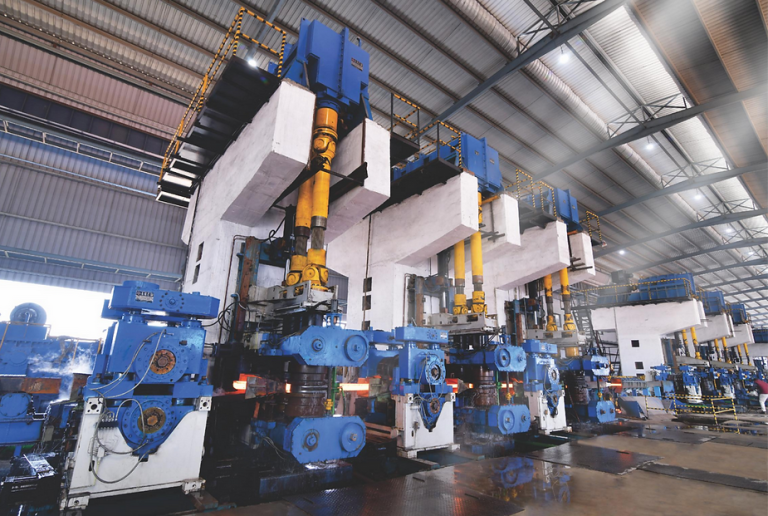
The heated billets pass through rolling stands, where they are reduced to the required diameter and shaped into reinforcement bars.
4. Rapid Water Cooling
The hot-rolled bars pass through a controlled water-cooling system.
This creates a hardened outer layer while the core remains hot.
5. Self-Tempering
Heat from the core flows towards the outer layer, helping temper the hardened surface.
6. Atmospheric Cooling
The bars are placed on a cooling bed, where the core cools under controlled atmospheric conditions.
7. Testing and Quality Control
Finished bars undergo relevant inspections and tests to verify their dimensions, mechanical properties and compliance with the applicable standard.
A controlled manufacturing process is important for achieving the specified strength and ductility of TMT reinforcement.
Why Integrated Steel Manufacturing Matters
Integrated steel manufacturing connects different stages of production within a coordinated manufacturing system.
A typical production chain may include:
Raw Materials → Sponge Iron/DRI → Steel Melting → Billet Casting → Rolling → Finished Steel Products
This approach can give manufacturers greater control over the movement of raw materials and intermediate products.
It also provides opportunities for monitoring quality at different production stages.
For example, Ambashakti’s manufacturing ecosystem includes sponge iron, steel billets and finished steel products.
Steel billet quality is particularly important because billets are used as the raw material for producing TMT bars and other rolled steel products.
Consistent billet chemistry, casting quality and rolling processes contribute to maintaining the specified properties of finished products.
How to Identify Genuine TMT Steel Bars Before Buying
Counterfeit or improperly documented reinforcement can create serious procurement and quality risks.
Before purchasing TMT bars, follow these checks.
1. Check the Manufacturer’s Marking
Look for the manufacturer’s identification and relevant product markings on the bars.
2. Verify the Grade
Ensure that the grade supplied matches the grade mentioned in the purchase order and structural specifications.
3. Check BIS Certification
Verify the applicable BIS licence and product certification through official BIS resources.
4. Check Bar Dimensions
Confirm the diameter and length of the bars against the required specifications.
5. Verify Weight
Compare the actual weight with the theoretical weight and applicable permissible tolerances.
6. Request Test Documentation
Ask for the relevant mill test certificate or product test documentation.
7. Buy Through Verified Dealers
Purchase from authorised or verified dealers to improve traceability and reduce the risk of counterfeit products.
A visual inspection alone cannot confirm the complete mechanical properties of reinforcement steel. Testing and product documentation are important.
Which Steel Grade Is Suitable for Different Construction Projects?
The appropriate steel grade depends on the structural design, loading conditions, seismic requirements and environmental exposure.
| Project requirement | Important considerations |
|---|---|
| Residential buildings | Grade and diameter specified by the structural engineer |
| High-rise buildings | Strength, ductility and structural design |
| Earthquake-prone regions | Seismic detailing and specified ductile reinforcement |
| Coastal construction | Corrosion exposure and appropriate corrosion protection |
| Industrial structures | Structural loads and product-specific specifications |
| Bridges and infrastructure | Project specifications, mechanical properties and durability |
Is Ductility Important for Earthquake-Resistant Construction?
Yes. Ductility is an important consideration in earthquake-resistant structural design.
During seismic activity, structures can experience repeated loading and deformation. Reinforcement with suitable ductility helps structural members accommodate these deformations when used as part of a properly designed and detailed structural system.
However, earthquake resistance does not depend on the TMT grade alone.
It also depends on:
- Structural design.
- Seismic zone and applicable building codes.
- Reinforcement detailing.
- Concrete quality.
- Construction workmanship.
- Foundation design.
- Quality of materials.
Always follow the recommendations of a qualified structural engineer.
Steel Prices in India in 2026
Steel prices in India vary according to product category, grade, diameter, manufacturer, location, order quantity and prevailing market conditions.
For TMT reinforcement bars, the final purchase price may depend on:
- TMT grade.
- Bar diameter.
- Brand and manufacturer.
- Quantity ordered.
- Transportation costs.
- Dealer margins.
- Applicable taxes.
- Market demand and raw-material prices.
Buyers should compare quotations for equivalent grades, dimensions, quantities and delivery terms rather than comparing prices alone.
For Ambashakti’s product-specific pricing information, visit the TMT Bar Price in India page.
You can also explore location-specific TMT prices to understand regional price differences.
Why the Cheapest Steel Is Not Always the Best Choice
Price is an important part of construction procurement, but the lowest quotation should not automatically determine the purchase decision.
Steel products with different grades, specifications or certification status cannot be compared fairly on price alone.
Before finalising a supplier, compare:
- Product grade.
- Applicable BIS standard.
- Diameter and dimensions.
- Mechanical properties.
- Product certification.
- Weight and quantity.
- Test documentation.
- Delivery terms.
- Transportation and taxes.
Selecting steel that meets the project’s technical requirements is more important than choosing a product solely because it has a lower price.
Sustainability and Green Steel Manufacturing
Sustainability is becoming an important consideration in the Indian steel industry.
Steel manufacturers are exploring different approaches to improve resource efficiency and reduce environmental impact.
These include:
- Recycling steel scrap.
- Improving energy efficiency.
- Recovering waste heat.
- Optimising raw-material consumption.
- Improving production efficiency.
- Adopting environmental management systems.
- Exploring lower-emission steelmaking technologies.
Steel is a recyclable material, and recycling can help reduce the demand for virgin raw materials.
Ambashakti’s Green Steel initiative describes its approach to recycled inputs, energy recovery, integrated manufacturing and environmental management.
Learn more about Ambashakti Green Steel and the role of sustainable steel in construction.
Frequently Asked Questions About Steel Brands in India
1. Which are the top 10 steel brands in India in 2026?
Some notable steel manufacturers and brands in India include Ambashakti, Tata Steel, JSW Steel, SAIL, Jindal Steel & Power, AM/NS India, RINL – Vizag Steel, Shyam Steel, SRMB and Rungta Steel.
They operate across different steel manufacturing segments and offer products for construction, infrastructure and industrial applications.
2. Which is the best steel brand for house construction in India?
The right steel brand depends on the structural requirements, TMT grade, product certification, mechanical properties, availability and project budget.
Buyers should compare the technical specifications of the actual reinforcement product rather than selecting a manufacturer based on brand recognition alone.
3. Which steel manufacturers produce TMT bars in India?
Several Indian manufacturers supply TMT reinforcement products, including Ambashakti, Tata Steel, JSW Steel, SAIL, Jindal Steel & Power, RINL, Shyam Steel, SRMB and Rungta Steel.
The available grades and sizes should be confirmed with each manufacturer.
4. What is the difference between TMT bars and structural steel?
TMT bars are reinforcement products used inside concrete structures to provide tensile reinforcement.
Structural steel includes angles, channels, beams, plates and sections used in frameworks, fabrication and other structural applications.
5. Which TMT grade is suitable for house construction?
The appropriate TMT grade depends on the structural design and engineering specifications.
Grades such as Fe500, Fe500D, Fe550 and Fe550D may be specified for different construction requirements.
Consult a structural engineer before choosing a grade.
6. Which TMT grade is suitable for earthquake-resistant construction?
The appropriate grade depends on the seismic design, structural detailing and applicable building codes.
Ductility is particularly important in seismic applications. Fe500D and Fe550D provide enhanced ductility requirements compared with their corresponding non-D grades, but the engineer must specify the appropriate reinforcement.
7. What should I check before buying TMT bars?
Check the manufacturer’s marking, grade, BIS certification, diameter, weight, mechanical properties, test documentation and dealer authenticity.
The supplied product should match the specifications mentioned in the structural drawings and purchase order.
8. Why is billet quality important in steel manufacturing?
Billets are semi-finished products used as raw material for manufacturing TMT bars and other rolled steel products.
Their chemical composition, casting quality and consistency can influence the properties of finished steel.
9. Do steel prices vary across different Indian cities?
Yes. Steel prices can vary according to the manufacturer, grade, diameter, local demand, transportation, taxes and dealer margins.
Always compare the final delivered price for equivalent products.
10. What is integrated steel manufacturing?
Integrated steel manufacturing connects multiple production stages, such as raw-material processing, sponge iron production, steelmaking, billet casting and rolling.
It can help manufacturers maintain control over different stages of production and quality management.
11. What certifications should buyers check when purchasing steel?
For TMT reinforcement, check the applicable BIS certification and compliance with IS 1786.
Also review relevant product test reports and quality documentation. Other steel products may follow different product-specific standards.
12. Why is corrosion resistance important in construction steel?
Corrosion can reduce the effective cross-section of reinforcement and affect the durability of reinforced concrete structures.
For coastal, marine or aggressive environments, suitable corrosion protection and corrosion-resistant reinforcement may be required according to project specifications.
Related Resources for Construction Buyers
Explore these additional Ambashakti resources to understand steel grades, product specifications and construction requirements.
- Top 10 TMT Bars in India 2026 – Best TMT Bar Brands for Construction
- Best TMT Bars for House Construction
- How to Check TMT Bar Weight at Site
- TMT Bar Price in India
- Ambashakti TMT Bars
- Ambashakti Steel Billets
- Ambashakti Angles & Channels
- Ambashakti Green Steel
Conclusion
India’s steel industry includes several established manufacturers serving residential construction, commercial buildings, infrastructure, engineering and industrial applications.
Companies such as Ambashakti, Tata Steel, JSW Steel, SAIL, Jindal Steel & Power, AM/NS India, RINL, Shyam Steel, SRMB and Rungta Steel offer different products and manufacturing capabilities.
However, choosing the right steel manufacturer requires more than comparing company names. Buyers should evaluate the specific product, grade, strength, ductility, applicable standards, quality testing, availability and overall procurement cost.
For residential and infrastructure projects, TMT reinforcement should always match the structural design and relevant engineering requirements.
Ambashakti offers a range of construction steel products, including FE550, FE550D and FE550 CRS TMT bars, steel billets, sponge iron and structural angles and channels.
Explore Ambashakti’s steel product portfolio to learn more about its manufacturing capabilities and construction steel solutions.
Build with the right steel. Choose quality that meets your project’s requirements.