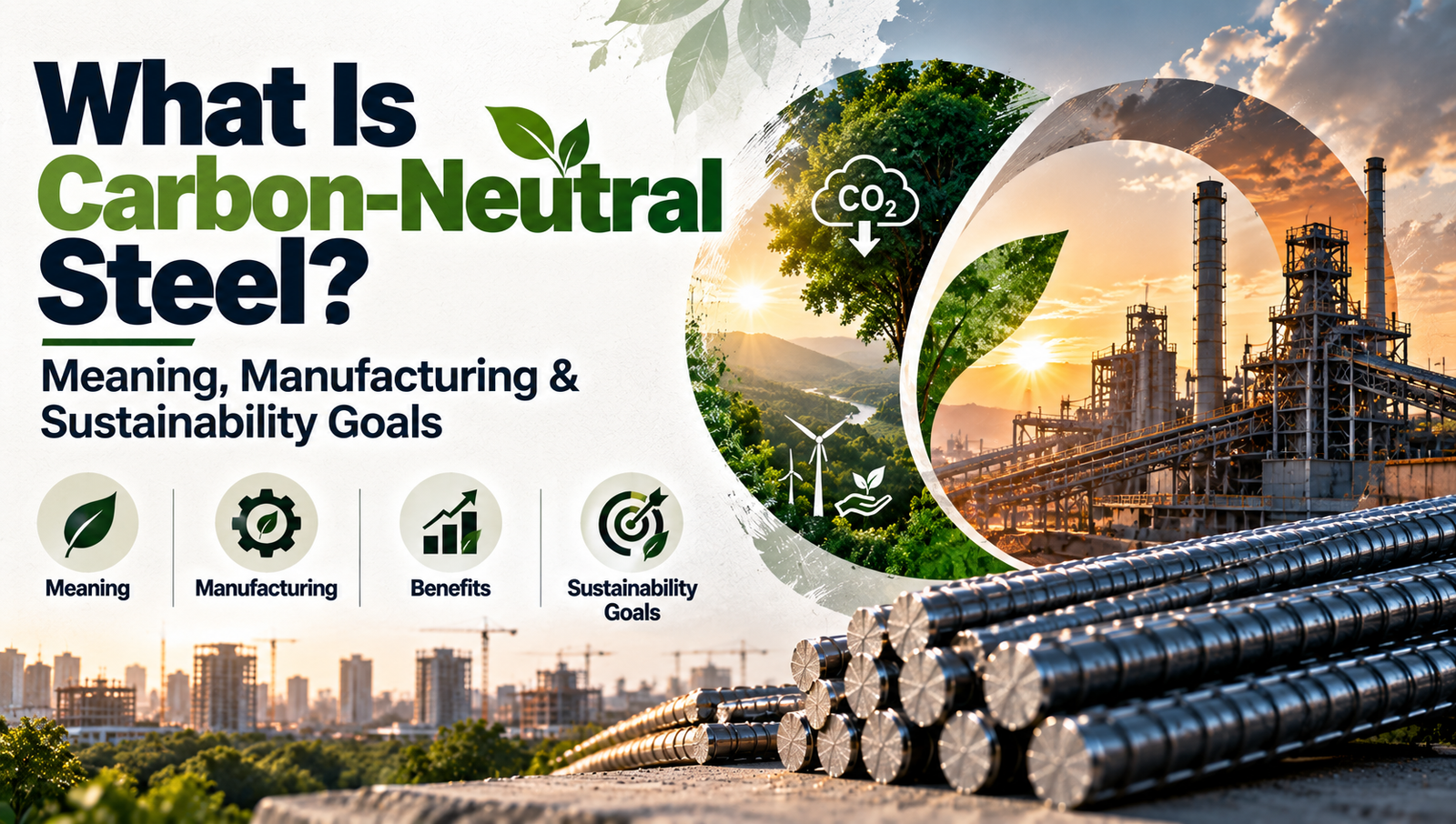

As the steel industry works to reduce greenhouse-gas emissions, terms such as carbon-neutral steel, low-carbon steel, green steel and net-zero steel are becoming increasingly common.
But what does carbon-neutral steel actually mean?
Carbon-neutral steel generally refers to steel for which greenhouse-gas emissions associated with its production are balanced by verified emissions removals or other mechanisms under a defined accounting methodology. The exact meaning depends on the emissions boundary, accounting method and how residual emissions are addressed.
This is different from simply producing steel with lower emissions.
In this guide, we explain what carbon-neutral steel means, how it can be produced, how it differs from low-carbon and green steel, the technologies used to reduce emissions, and what sustainability goals mean for construction and steel buyers.
Important: “Carbon-neutral,” “green” and “low-carbon” are not interchangeable labels. Buyers should examine the manufacturer’s emissions boundary, calculation methodology, verification and any use of offsets or removals before comparing sustainability claims.
Quick Answer: What Is Carbon-Neutral Steel?
Carbon-neutral steel refers to steel for which the greenhouse-gas emissions associated with its production are balanced by greenhouse-gas removals or other qualifying mechanisms under a defined accounting framework.
The World Steel Association defines carbon-neutral steel as steel where a balance can be achieved between greenhouse gases released during production and emissions removed through measures such as carbon capture and permanent storage, while noting that carbon-neutrality claims require transparency around boundaries, accounting methods and offsets.
In simple terms:
Emissions produced → emissions reduced → remaining emissions addressed → net balance
However, carbon-neutrality does not mean that the steel manufacturing process necessarily produces zero emissions at every stage.
What Does Carbon Neutral Mean?
Carbon neutrality is based on balancing emissions with removals or other qualifying measures within a defined accounting framework.
For steel production, this can involve:
- Reducing emissions from energy and fuel use
- Increasing the use of recycled steel
- Improving energy efficiency
- Using lower-carbon electricity
- Recovering waste heat
- Reducing process emissions
- Using carbon capture and storage where technically applicable
- Addressing residual emissions through credible mechanisms
The crucial point is that the accounting boundary matters.
For example, a carbon-neutral claim may define emissions from a particular production facility, product lifecycle stage or broader value chain. The buyer therefore needs to understand exactly what is included.
The IEA has emphasised the need for common definitions and consistent emissions-measurement methodologies for low- and near-zero-emissions industrial products.
Carbon-Neutral Steel vs Low-Carbon Steel
These terms describe related but different concepts.
Low-carbon steel
Low-carbon steel is steel manufactured through technologies and practices that result in significantly lower greenhouse-gas emissions than conventional production.
Carbon-neutral steel
Carbon-neutral steel generally means that the remaining emissions are balanced by qualifying removals or other mechanisms under a defined methodology.
Therefore:
Low-carbon = significantly lower emissions
Carbon-neutral = emissions balanced under a defined framework
A steel product can be low-carbon without being carbon-neutral.
Carbon-Neutral Steel vs Green Steel
“Green steel” is a broader and less consistently defined term.
The World Steel Association notes that the phrase green steel is used in different ways, including steel produced using breakthrough technologies, recycled steel, renewable energy or carbon-offsetting approaches.
That means a company calling a product “green steel” does not, by itself, establish that the product is carbon-neutral.
For buyers, the better approach is to ask:
- What emissions are included?
- What production boundary is used?
- What is the emissions intensity?
- How much is actually reduced?
- Are removals involved?
- Are offsets used?
- Is the claim independently verified?
Ambashakti currently describes its Green Steel approach in terms of recycled inputs, recovered energy, captive power and solar power, while stating that its applicable TMT products continue to meet IS 1786 requirements.
Explore Ambashakti Green Steel
How Is Carbon-Neutral Steel Produced?
There is no single process for producing carbon-neutral steel.
Instead, carbon neutrality can involve a combination of emissions-reduction technologies and mechanisms for addressing residual emissions.
A simplified steelmaking pathway can look like:
Raw Materials → Ironmaking / Scrap Preparation → Steelmaking → Casting → Rolling → Finished Steel
Emissions can arise at multiple stages.
A carbon-neutral pathway therefore focuses on reducing emissions throughout the production system and then addressing residual emissions under the applicable framework.
1. Recycled Steel Scrap
Using recycled steel is one important route for reducing the need for virgin ironmaking.
Steel can be recycled repeatedly, and scrap can be remelted to manufacture new steel products. Worldsteel identifies scrap as an important input in steelmaking and notes its potential to reduce the need for virgin raw materials.
However, scrap alone does not make steel carbon-neutral.
The overall emissions profile also depends on:
- Electricity source
- Furnace technology
- Transport
- Processing
- Material efficiency
- Other production inputs
Ambashakti’s Green Steel page states that recycled steel scrap forms a significant part of its melting charge.
Learn About Ambashakti Green Steel
2. Direct Reduced Iron
Direct Reduced Iron, or DRI, is another important input in steelmaking.
DRI is produced by removing oxygen from iron ore without melting the iron ore completely.
The carbon intensity of DRI depends heavily on the reducing agent and energy source.
Natural-gas-based DRI can provide a lower-emissions route than some conventional ironmaking processes, while hydrogen-based DRI is being developed for deeper decarbonisation.
Ambashakti produces sponge iron/DRI and uses it as an iron-bearing input in its steelmaking system.
Explore Ambashakti Sponge Iron
3. Electric and Induction Melting
Electric furnaces can melt scrap and other metallic inputs using electricity instead of relying on the same type of coal-intensive process used in traditional blast-furnace ironmaking.
The emissions profile depends significantly on the source of electricity.
Lower-carbon electricity can therefore reduce the emissions associated with electric steelmaking.
Ambashakti’s Green Steel information identifies high-efficiency induction melting as one of the process measures used in its manufacturing approach.
4. Renewable Electricity
Renewable electricity can reduce emissions associated with electricity consumption.
Potential sources include:
- Solar
- Wind
- Hydropower
- Other low-carbon electricity systems
Ambashakti’s Green Steel page identifies solar power and recovered captive power as part of its stated energy strategy.
This is one reason energy sourcing should be considered when evaluating the carbon footprint of steel.
5. Waste-Heat Recovery
Steel and ironmaking processes produce significant quantities of heat.
Instead of allowing this energy to be lost, waste-heat recovery systems can capture and use it to generate useful power or process heat.
Ambashakti describes recovering energy from DRI kiln gases through waste-heat recovery systems to generate captive power.
Explore Ambashakti Sponge Iron
6. Process Efficiency
Improving efficiency can reduce the amount of energy and raw material needed per tonne of finished steel.
Efficiency improvements can include:
- High-efficiency furnaces
- Better process control
- Reduced reheating
- Continuous casting
- Improved rolling efficiency
- Heat recovery
- Reduced material losses
Ambashakti describes integrated manufacturing as a way of reducing transport requirements and intermediate reheating between production stages.
Explore Ambashakti Steel Plants
7. Carbon Capture and Storage
Carbon Capture and Storage, or CCS, is another potential pathway for addressing emissions from industrial processes.
The basic concept is:
CO₂ generated → captured → transported → permanently stored
For steelmaking routes that continue to produce process or combustion emissions, CCS can potentially reduce the amount of CO₂ released into the atmosphere.
Worldsteel specifically references carbon capture and storage when defining pathways toward carbon-neutral steel.
However, CCS requires:
- Significant investment
- Appropriate capture technology
- CO₂ transport infrastructure
- Suitable storage sites
- Long-term monitoring
It is therefore one part of the broader decarbonisation toolkit rather than a universal solution.
8. Hydrogen-Based Steelmaking
Hydrogen is being investigated as a pathway to reduce emissions from primary ironmaking.
In hydrogen-based direct reduction, hydrogen can act as a reducing agent:
Iron Oxide + Hydrogen → Iron + Water
This can potentially remove much of the carbon associated with conventional coal-based reduction at the ironmaking stage.
Hydrogen-based steelmaking still faces challenges involving:
- Availability of low-carbon hydrogen
- Renewable electricity requirements
- Infrastructure
- Technology scale-up
- Capital cost
- Product economics
Therefore, hydrogen is an emerging pathway rather than a universal current solution.
The Role of Steel Billets
Billets are an intermediate product in the production of many long steel products.
A simplified route is:
Scrap / DRI → Steel Melting → Continuous Casting → Billets → Rolling → TMT Bars / Structural Sections
The billet stage is important because billet quality affects the consistency of downstream rolled products.
Ambashakti describes billet production as part of its integrated steel manufacturing system.
Explore Ambashakti Steel Billets
Can Carbon-Neutral Steel Have the Same Strength?
Yes. The environmental classification of steel and its mechanical properties are separate considerations.
A steel product still needs to meet its relevant technical specification and applicable standard.
For reinforcement steel, buyers should evaluate:
- Grade
- Yield strength
- Tensile strength
- Ductility
- Diameter
- Weight
- Rib geometry
- Applicable BIS/IS standard
- Test documentation
Ambashakti’s current Green Steel page states that its green TMT products maintain the same IS 1786 standards as conventional bars, with the stated distinction being in the manufacturing inputs and energy rather than structural strength.
Carbon-Neutral Steel and Construction
Steel is widely used in:
- Residential buildings
- Commercial buildings
- Industrial facilities
- Bridges
- Roads
- Rail infrastructure
- Renewable-energy projects
For construction companies, carbon-neutral or lower-carbon steel can be relevant when projects have:
- Embodied-carbon targets
- Green-building requirements
- ESG objectives
- Sustainability procurement policies
- Scope 3 reduction goals
- Environmental reporting requirements
However, steel is only one part of a building’s overall environmental footprint.
Construction projects should evaluate steel alongside:
- Cement and concrete
- Glass
- Aluminium
- Transportation
- Construction waste
- Building operations
- End-of-life recovery
How to Verify a Carbon-Neutral Steel Claim
This is one of the most important parts of evaluating carbon-neutral steel.
Do not rely solely on the words “carbon neutral” or “net zero.”
Ask the manufacturer for evidence.
1. What Is the Emissions Boundary?
Does the claim cover:
- Manufacturing only?
- Raw materials?
- Transport?
- Scope 1?
- Scope 2?
- Scope 3?
2. What Is the Carbon Footprint?
Look for greenhouse-gas emissions expressed per tonne of steel.
3. What Methodology Was Used?
A credible claim should identify its accounting methodology.
The IEA has highlighted the importance of harmonised definitions and emissions-measurement methodologies for low- and near-zero-emissions materials.
4. How Were Residual Emissions Addressed?
Determine whether remaining emissions were:
- Permanently removed
- Captured and stored
- Addressed through other mechanisms
- Offset outside the company’s value chain
5. Is the Claim Independently Verified?
Third-party verification can provide additional confidence in environmental claims.
6. What Is the Product-Specific Evidence?
A company-level sustainability claim does not necessarily mean that every steel product has the same emissions profile.
Ask for information relevant to the actual product being purchased.
Carbon Neutral Steel vs Low Carbon Steel vs Green Steel
| Term | General Meaning | What Buyers Should Check |
| Low-carbon steel | Steel produced with significantly lower GHG emissions than a conventional baseline | Emissions intensity and baseline |
| Green steel | Broad market term used for steel with reduced environmental or carbon impact | Exact definition and evidence |
| Carbon-neutral steel | Emissions are balanced by qualifying removals or other mechanisms under a defined framework | Boundary, methodology, removals/offsets |
| Near-zero steel | Steel produced with emissions approaching very low levels compatible with a net-zero energy system | Threshold and measurement methodology |
Worldsteel specifically notes that “green steel” is used by different parties to describe different production approaches, while it defines low-carbon steel around significantly reduced emissions and carbon-neutral steel around balancing emissions and removals.
Is Carbon-Neutral Steel the Same as Zero-Carbon Steel?
No.
Zero-carbon steel would imply that no relevant carbon emissions are produced.
Carbon-neutral steel is different because emissions can still occur during production, with residual emissions addressed through qualifying removals or other mechanisms under a defined accounting framework.
Worldsteel notes that truly zero-carbon steel represents a very high bar and distinguishes it from carbon-neutral or net-zero steel.
Can Carbon Offsets Make Steel Carbon Neutral?
Offsets can be part of some carbon-neutral claims, but this requires careful examination.
The World Steel Association specifically cautions that carbon-neutrality claims should be transparent about boundaries, accounting methodologies and the quality and credibility of offsets used. It also distinguishes actual emissions reductions and permanent removals from simply compensating for emissions elsewhere.
For procurement teams, it is therefore useful to ask:
How much of the emissions reduction came from changes in the steelmaking process, and how much was addressed through external mechanisms?
Ambashakti and Lower-Carbon Steel Production
Ambashakti currently presents its Green Steel approach around changing the inputs and energy used in production while maintaining applicable product standards. Its Green Steel page identifies:
- Recycled steel scrap
- In-house DRI
- Captive power
- Waste-heat recovery
- High-efficiency induction melting
- Solar power
- Integrated manufacturing
- Closed-loop water management
The page states that its applicable green TMT bars meet the same IS 1786 standards as conventional bars.
Explore Ambashakti Green Steel
This is an example of emissions-reduction and resource-efficiency measures. It should not automatically be interpreted as a claim that every Ambashakti steel product is carbon-neutral. Carbon-neutrality requires a separate, defined accounting and balancing framework.
From Recycled Inputs to Finished TMT Bars
Ambashakti’s stated Green Steel production approach can be illustrated as:
Recycled Scrap + In-House DRI
↓
Efficient Steel Melting
↓
Continuous Casting
↓
Steel Billets
↓
Integrated Rolling
↓
Finished TMT Bars / Structural Steel
This integrated approach is designed to reduce material losses, energy losses, unnecessary transport and intermediate reheating.
You can explore the individual manufacturing stages through:
Carbon-Neutral Steel and Sustainable Construction
Carbon-neutral steel can become relevant when developers and infrastructure companies are trying to reduce the embodied carbon of construction materials.
Potential applications include:
Green Buildings
Projects pursuing sustainability certifications may track the embodied carbon of structural materials.
Infrastructure
Bridges, metros, highways and other large infrastructure projects can involve substantial steel quantities, making material carbon intensity relevant to procurement.
Industrial Construction
Factories, warehouses and industrial facilities may have corporate sustainability or Scope 3 objectives.
Renewable-Energy Infrastructure
Wind turbines, solar infrastructure and transmission systems require large volumes of steel, creating a connection between steel decarbonisation and the broader energy transition.
Challenges in Carbon-Neutral Steel Production
Producing steel with very low or net-zero emissions remains technically and economically challenging.
High Investment Requirements
New furnaces, renewable power, hydrogen systems, CCS and supporting infrastructure require substantial investment.
Limited Scrap Availability
Steel demand cannot currently be met entirely through scrap because the quantity of available end-of-life steel is limited.
Hydrogen Availability
Hydrogen-based steelmaking requires sufficient supplies of low-carbon hydrogen.
Electricity Requirements
Electric steelmaking requires large amounts of electricity, making the carbon intensity of the power source important.
Carbon Accounting
Different methodologies can produce different results if they use different system boundaries or assumptions.
Cost Competitiveness
Lower-carbon steel can involve additional costs, especially during early technology deployment.
What Should Steel Buyers Look for in 2026?
Companies evaluating carbon-neutral or low-carbon steel can use this checklist:
| Evaluation Area | What to Check |
| Carbon intensity | kg or tonnes CO₂e per tonne of steel |
| Boundary | Scope 1, 2 and/or 3 |
| Production route | BF-BOF, EAF, induction, DRI-EAF etc. |
| Raw materials | Scrap, DRI, ore and other inputs |
| Energy | Grid, renewable, captive or recovered energy |
| Carbon removals | Type and permanence |
| Offsets | Whether and where they are used |
| Verification | Third-party assurance |
| Product standard | Applicable BIS/IS or other standard |
| Traceability | Product and batch documentation |
Frequently Asked Questions
What is carbon-neutral steel?
Carbon-neutral steel generally refers to steel for which greenhouse-gas emissions from production are balanced by qualifying emissions removals or other mechanisms under a defined accounting framework. The exact claim depends on the emissions boundary and methodology.
Is carbon-neutral steel the same as green steel?
No. Green steel is a broader and less consistently defined term. Carbon-neutral steel specifically relates to balancing greenhouse-gas emissions under a defined framework.
Is carbon-neutral steel the same as low-carbon steel?
No. Low-carbon steel refers to significantly reducing emissions compared with a conventional baseline. Carbon-neutral steel additionally involves balancing remaining emissions through defined removals or other qualifying mechanisms.
Does carbon-neutral steel contain carbon?
Yes. Carbon-neutral refers to the greenhouse-gas balance associated with production; it does not mean that the steel itself must contain zero carbon.
How is carbon-neutral steel produced?
It can involve a combination of lower-emission production technologies, recycled steel, efficient energy use, renewable electricity, waste-heat recovery, carbon capture and other mechanisms for addressing residual emissions.
Can recycled steel be carbon neutral?
Recycled steel can have a lower emissions intensity, but recycling alone does not automatically make a product carbon-neutral. The full production footprint and accounting methodology must be considered.
What is the role of hydrogen in carbon-neutral steel?
Hydrogen can potentially replace carbon-based reducing agents in some primary ironmaking processes. Hydrogen-based DRI is being developed as a pathway toward substantially lower emissions.
Can carbon offsets make steel carbon neutral?
Some carbon-neutral claims may use offsets, but buyers should examine the offset type, accounting boundary, permanence, verification and the share of emissions actually reduced within the steelmaking process.
Is carbon-neutral steel suitable for construction?
Yes, provided the specific steel product meets the engineering requirements and applicable product standards for the intended construction application.
How does Ambashakti approach sustainable steel production?
Ambashakti’s Green Steel page describes the use of recycled scrap, in-house DRI, recovered waste heat, high-efficiency induction melting, captive power, solar power and integrated manufacturing.
Related Ambashakti Resources
What Is Green Steel? Benefits, Manufacturing Process & Future Applications
Learn the meaning of green steel, its manufacturing approaches, benefits and future applications.
Green Steel Manufacturing Process Explained
Understand how steel moves from raw materials through steelmaking, casting and rolling.
Read the Green Steel Manufacturing Guide
Green Steel vs Traditional Steel
Explore the differences between green and traditional steel production, including energy use, recycled inputs and environmental considerations.
Read Green Steel vs Traditional Steel
Sustainable Steel vs Conventional Steel
Understand how sustainable steel production differs from conventional production in terms of resources, energy and emissions.
Read Sustainable Steel vs Conventional Steel
Low-Carbon Steel Production
Explore technologies and approaches used to reduce emissions from steelmaking.
Read the Low-Carbon Steel Guide
Ambashakti Green Steel
Explore Ambashakti’s stated approach to recycled inputs, recovered energy, captive power, solar power and integrated manufacturing.
Ambashakti TMT Bars
Explore TMT grades, specifications, manufacturing and quality information.
Steel Billets
Learn about billet production and its role in finished long-steel products.
Sponge Iron
SLearn about Direct Reduced Iron and its role in steelmaking.
Final Takeaway
Carbon-neutral steel refers to steel for which greenhouse-gas emissions are balanced under a defined accounting and emissions-removal framework. It is therefore different from simply producing steel with lower emissions.
The pathway toward carbon-neutral steel can involve a combination of:
- Recycled steel
- Energy efficiency
- Electric or induction melting
- Renewable electricity
- DRI
- Hydrogen-based ironmaking
- Waste-heat recovery
- Carbon capture
- Verified treatment of residual emissions
For buyers, the most important step is to look beyond sustainability terminology and examine the actual emissions data, measurement boundary, production route, verification and product standards.
Ambashakti currently positions its Green Steel production around recycled inputs, in-house DRI, recovered energy, captive and solar power, efficient induction melting and integrated manufacturing, while maintaining applicable IS 1786 standards for its relevant TMT products.