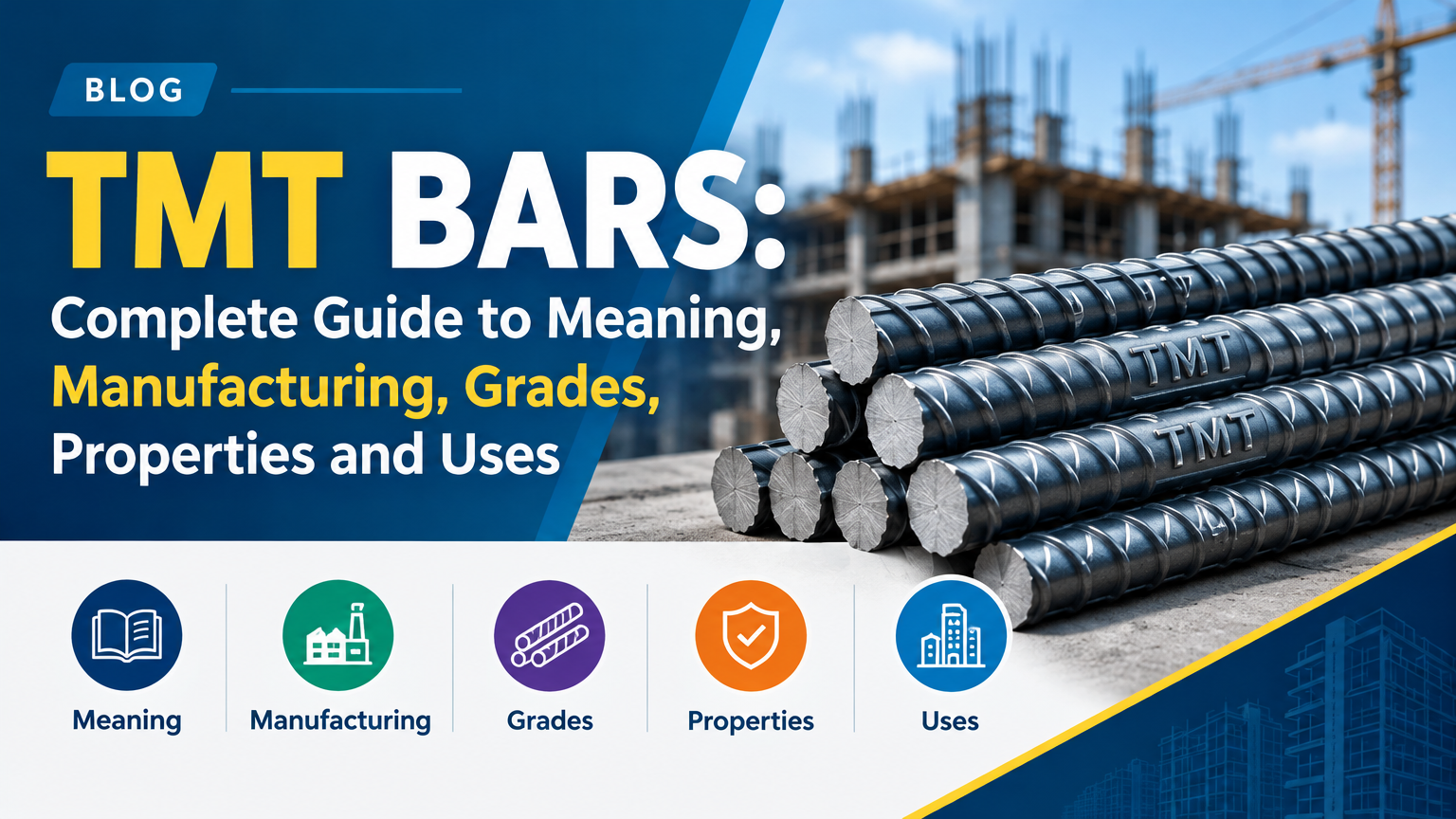

TMT bars, also known as Thermo-Mechanically Treated bars, are high-strength steel reinforcement bars used in reinforced cement concrete (RCC) construction. TMT bars provide the tensile reinforcement that concrete needs to withstand bending forces and other structural loads.
TMT bars are manufactured through a controlled process of hot rolling, rapid water quenching, self-tempering and atmospheric cooling. This process develops a hard outer layer and a comparatively ductile inner core, giving the reinforcement steel its characteristic combination of strength and ductility.
TMT bars are widely used in residential buildings, commercial complexes, high-rise structures, bridges, industrial facilities and infrastructure projects. They are available in different grades and diameters to meet specific structural requirements.
This guide explains what TMT bars are, how TMT bars are manufactured, their grades, properties, sizes, applications, testing standards and the factors to consider when selecting TMT reinforcement for construction.
TMT Bars at a Glance
| Parameter | Details |
|---|---|
| Full form | Thermo-Mechanically Treated |
| Material | Steel reinforcement |
| Primary application | Reinforced cement concrete construction |
| Manufacturing process | Hot rolling, rapid quenching and self-tempering |
| Main properties | Strength, ductility and bonding with concrete |
| Indian product standard | IS 1786 |
| Common grades | Fe415, Fe500, Fe500D, Fe550, Fe550D and Fe600 |
| Common diameters | 8 mm to 40 mm, depending on manufacturer |
| Applications | Houses, buildings, bridges and infrastructure |
What are TMT bars used for? TMT bars reinforce concrete structures by providing tensile strength. They are used in foundations, columns, beams, slabs, bridges and other RCC components according to structural design requirements.
For product information, explore Ambashakti TMT Bars.
1. What Are TMT Bars?
TMT stands for Thermo-Mechanically Treated. TMT bars are steel reinforcement bars manufactured using a combination of thermal and mechanical processes.
During production, hot-rolled steel bars undergo rapid water cooling followed by self-tempering and atmospheric cooling. This creates a characteristic cross-sectional structure consisting of a hardened outer region and a relatively ductile inner core.
TMT bars are used with concrete because concrete is strong under compression but comparatively weak under tension. Reinforcement steel helps concrete structures resist tensile stresses and bending forces.
The ribbed surface of TMT bars also helps create mechanical interlock with the surrounding concrete.
Why are TMT bars important in construction?
TMT bars are important in RCC construction because they:
- Provide tensile reinforcement to concrete members.
- Help beams, columns, slabs and foundations resist structural loads.
- Offer a combination of strength and ductility.
- Provide mechanical bonding through their ribbed surface.
- Can be cut and bent according to approved reinforcement drawings and procedures.
The structural performance of an RCC building depends on the combined design and execution of concrete, reinforcement, connections, detailing and workmanship.
Explore: Ambashakti TMT Bars – Product Range and Specifications.
2. How Are TMT Bars Manufactured?
The TMT bar manufacturing process involves two main stages: steelmaking and thermo-mechanical treatment.
Steelmaking produces the billets used as raw material. The subsequent rolling and cooling process gives the finished TMT bars their required shape and mechanical properties.
A. Steelmaking and Billet Production
1. Raw Material Preparation
Iron-bearing raw materials and other inputs are selected and prepared for steel production. Their quality influences the chemical composition of the resulting steel.
2. Ironmaking
In an integrated steelmaking route, iron ore is processed to produce sponge iron. Sponge iron is an important metallic input for steelmaking.
3. Steel Melting and Refining
The metallic inputs are melted to produce liquid steel. The chemical composition is controlled according to the intended steel grade and product requirements.
4. Billet Casting
Liquid steel is cast into semi-finished steel sections called billets. These billets are used as the input material for the rolling mill.
B. Thermo-Mechanical Treatment Process
<Add an original manufacturing-process diagram: Billet Reheating → Hot Rolling → Rapid Water Quenching → Self-Tempering → Atmospheric Cooling → Cutting and Testing.>
1. Billet Reheating
Steel billets are heated in a reheating furnace to the temperature required for rolling.
2. Hot Rolling
The heated billets pass through rolling stands, where they are progressively reduced to the required diameter and formed into ribbed reinforcement bars.
3. Rapid Water Quenching
Immediately after rolling, the hot bars pass through a controlled water-cooling system. The outer surface cools rapidly and develops a hardened martensitic layer, while the inner core remains hot.
4. Self-Tempering
Heat from the hot inner core moves towards the cooler outer layer. This process tempers the outer region and contributes to the combination of strength and ductility.
5. Atmospheric Cooling
The bars are transferred to a cooling bed, where they cool under atmospheric conditions. The core undergoes further metallurgical transformation, developing the final internal structure.
6. Cutting, Testing and Bundling
The finished TMT bars are cut to specified lengths, inspected and tested according to applicable requirements before being bundled for dispatch.
Why is controlled cooling important in TMT bar manufacturing?
Controlled cooling helps develop the required metallurgical structure across the bar’s cross-section. Consistency in rolling temperature, water quenching and cooling conditions is important for achieving the specified mechanical properties.
Learn more about Ambashakti’s Steel Quality Process, including its integrated steel manufacturing operations and quality-control measures.
3. What Is the Internal Structure of a TMT Bar?
A TMT bar generally has two main structural regions: a tempered martensitic outer layer and a ferrite-pearlite inner core.
| Region | Structure | Main contribution |
|---|---|---|
| Outer layer | Tempered martensite | Strength and hardness |
| Inner core | Ferrite-pearlite | Ductility and deformation capacity |
Tempered martensitic outer layer: The outer region forms during rapid cooling and subsequent self-tempering. It contributes to the strength and hardness of the TMT bar.
Ferrite-pearlite inner core: The inner core cools more gradually and develops a ferrite-pearlite structure. It contributes to the bar’s ductility.
The combination of these regions helps TMT bars achieve the strength and ductility required for reinforcement applications.
4. What Are the Important Properties of TMT Bars?
The most important TMT bar properties include yield strength, tensile strength, elongation, bendability, bond characteristics and chemical composition.
1. Yield Strength
Yield strength is the stress at which steel begins to undergo permanent deformation. It is expressed in megapascals (MPa).
For example, Fe550 TMT bars have a specified minimum yield strength of 550 MPa under the applicable standard.
2. Tensile Strength
Tensile strength is the maximum stress a steel bar withstands during a tensile test before failure.
It helps assess the mechanical strength of the reinforcement steel.
3. Ductility
Ductility is the ability of steel to deform before fracture. It is important when reinforcement experiences deformation under structural loading.
Elongation measurements are used to assess ductility.
4. Bendability
Bendability describes the ability of reinforcement steel to withstand specified bending requirements without unacceptable cracking or fracture.
Bend tests help evaluate this property. The specified bending procedure and mandrel diameter should follow the applicable standard and project requirements.
5. Bond with Concrete
TMT bars have ribs on their surface that help create mechanical interlock with surrounding concrete.
This bond supports the transfer of forces between reinforcement steel and concrete.
6. Weldability
Weldability depends on the steel’s chemical composition, carbon equivalent and welding procedure.
Welding should only be performed when permitted by the material specification and structural design, using an approved procedure.
7. Corrosion Resistance
Corrosion occurs when reinforcement steel is exposed to moisture, chlorides or other aggressive substances.
Corrosion performance depends on steel composition, concrete quality, concrete cover, exposure conditions and construction practices. Corrosion-resistant reinforcement may be specified for certain aggressive environments.
Related resource: Ambashakti’s TMT Bar Product Specifications.
5. What Are the Different Grades of TMT Bars?
TMT bar grades indicate the specified minimum yield strength of reinforcement steel. The grade designation is expressed as Fe followed by a number representing the minimum yield strength in MPa.
Some commonly encountered grades include:
| TMT Bar Grade | Minimum Yield Strength | Key distinction |
|---|---|---|
| Fe415 | 415 MPa | Specified minimum yield strength of 415 MPa |
| Fe500 | 500 MPa | Specified minimum yield strength of 500 MPa |
| Fe500D | 500 MPa | Fe500 grade with additional ductility requirements |
| Fe550 | 550 MPa | Specified minimum yield strength of 550 MPa |
| Fe550D | 550 MPa | Fe550 grade with additional ductility requirements |
| Fe600 | 600 MPa | Specified minimum yield strength of 600 MPa |
The letter D in grades such as Fe500D and Fe550D indicates additional ductility requirements under the applicable standard.
Which TMT bar grade is best for construction?
There is no single TMT grade that is best for every construction project. The appropriate grade depends on structural calculations, design requirements, ductility requirements, applicable codes and site conditions. The structural engineer should specify the grade and diameter.
Difference Between Fe550 and Fe550D TMT Bars
Both Fe550 and Fe550D have a specified minimum yield strength of 550 MPa. The key difference is that Fe550D has additional ductility requirements.
| Parameter | Fe550 | Fe550D |
|---|---|---|
| Minimum yield strength | 550 MPa | 550 MPa |
| Ductility requirements | As specified for Fe550 | Additional ductility requirements |
| Grade designation | Fe550 | Fe550D |
| Selection | Based on structural design | Based on structural design and ductility requirements |
The selection should be based on the applicable product standard and the structural engineer’s specification, not simply on the grade designation.
TMT Bar Grades Manufactured by Ambashakti
Ambashakti offers three TMT bar product grades:
Amba Shakti SD – Fe550
Fe550 reinforcement steel for construction applications requiring the specified strength and mechanical properties of this grade.
Amba Shakti Flexion – Fe550D
Fe550D reinforcement steel with additional ductility requirements under the applicable standard.
Amba Shakti Flexion CRS – Fe550 CRS
Fe550 CRS reinforcement steel intended for applications where the specified corrosion-resistance characteristics are required.
Explore the individual product information on the Ambashakti TMT Bars page.
6. What Is IS 1786 for TMT Bars?
IS 1786 is the Indian Standard covering high-strength deformed steel bars and wires for concrete reinforcement.
It specifies requirements relating to:
- Chemical composition.
- Yield strength.
- Tensile strength.
- Elongation.
- Bend and rebend performance.
- Dimensions and mass.
- Relevant product tolerances and other requirements.
BIS certification provides a conformity framework for products covered by the applicable Indian Standard.
When purchasing TMT bars, buyers should check the applicable BIS licence, product markings and test documentation.
Why is BIS certification important for TMT bars?
BIS certification helps buyers identify products that are certified as conforming to the relevant Indian Standard, subject to the licence’s scope and validity. Buyers should verify the manufacturer’s licence details rather than relying only on marketing claims.
For additional information about Ambashakti’s quality-control practices, visit the Steel Quality Process page.
7. What Tests Are Conducted on TMT Bars?
TMT bar testing helps verify whether reinforcement steel meets the mechanical, chemical and dimensional requirements of the applicable product standard.
| Test | What it checks |
|---|---|
| Tensile test | Yield strength, tensile strength and elongation |
| Bend test | Ability to withstand specified bending |
| Rebend test | Performance under prescribed bending and rebending |
| Chemical composition test | Percentage of specified chemical elements |
| Mass and dimensional checks | Nominal dimensions and mass requirements |
Tensile Test
A sample bar is subjected to tensile loading to determine its mechanical properties, including yield strength, tensile strength and elongation.
Bend Test
The test checks whether a bar can withstand bending around a specified mandrel without unacceptable cracking.
Rebend Test
The rebend test evaluates the bar’s performance under a prescribed bending, conditioning and rebending procedure.
Chemical Composition Test
Chemical analysis checks the levels of specified elements in the steel and helps establish compliance with the required chemical composition.
Mass and Dimensional Checks
The diameter, dimensions and mass of the bar are checked against applicable requirements and tolerances.
What is an MTC for TMT bars?
An MTC, or Mill Test Certificate, is a document containing test information for a supplied steel product or batch. Buyers should review the grade, relevant test results and traceability details and match them with the material delivered.
8. What Are the Applications of TMT Bars?
TMT bars are used in reinforced concrete structures where steel reinforcement is required by the structural design.
Residential Construction
TMT bars are used in RCC foundations, columns, beams, slabs, staircases and other structural components of houses and residential buildings.
Read our guide to choosing steel for house construction in India.
Commercial and High-Rise Buildings
Commercial complexes, offices and high-rise buildings require reinforcement selected according to structural loading, design calculations and applicable construction standards.
Bridges and Infrastructure
Bridges, flyovers, retaining structures and infrastructure projects use reinforcement steel selected according to design loads, exposure conditions and project specifications.
Industrial Structures
Factories, warehouses and industrial facilities use TMT reinforcement in foundations, columns, beams and other structural elements.
Coastal and Corrosion-Prone Construction
Structures exposed to marine environments, chlorides or aggressive soil and water conditions require specific durability measures.
Where required by the project specification, corrosion-resistant reinforcement such as CRS TMT bars may be considered alongside suitable concrete cover, concrete quality and other durability measures.
9. How Do TMT Bars Support Earthquake-Resistant Construction?
Ductility is an important property of reinforcement steel used in seismic-resistant structural design.
During an earthquake, buildings can experience repeated lateral movement and cyclic loading. Reinforcement with the required ductility helps structural members deform in a controlled manner under the conditions considered in the design.
However, TMT bars alone do not make a building earthquake-resistant.
Earthquake performance depends on:
- Structural configuration and design.
- Appropriate reinforcement grade and ductility.
- Beam-column joint detailing.
- Confinement reinforcement.
- Lap lengths and anchorage.
- Concrete quality and workmanship.
- Compliance with applicable seismic design and detailing standards.
Structural engineers must select reinforcement and design details in accordance with the applicable standards, including relevant provisions of IS 13920.
10. What Are the Common TMT Bar Sizes?
TMT bars are manufactured in different nominal diameters to meet the reinforcement requirements of different structural members.
Common nominal diameters include 8 mm, 10 mm, 12 mm, 16 mm, 20 mm, 25 mm, 32 mm and 40 mm.
| Nominal Diameter | Approximate Theoretical Weight per Metre |
|---|---|
| 8 mm | 0.395 kg |
| 10 mm | 0.617 kg |
| 12 mm | 0.888 kg |
| 16 mm | 1.580 kg |
| 20 mm | 2.470 kg |
| 25 mm | 3.850 kg |
| 32 mm | 6.310 kg |
| 40 mm | 9.860 kg |
These are theoretical nominal weights based on the nominal diameter and standard steel density. Actual supply should be checked against applicable mass tolerances.
Which TMT bar size should be used for a house?
There is no universal diameter for every part of a house. The required bar size depends on the structural design, loads, member dimensions and reinforcement detailing. Always follow the approved structural drawings and bar bending schedule.
Explore these resources:
- TMT Bar Weight Chart: 8 mm to 32 mm
- How to Check TMT Bar Weight at the Site
- Ambashakti TMT Bars: Available Diameters and Product Information
11. How to Choose the Right TMT Bars for Construction
Choosing TMT bars involves checking the grade, certification, material properties, dimensions and suitability for the project.
Use the following checklist before purchasing:
- Confirm the grade: Check the structural drawings and specifications for the required grade and ductility class.
- Verify BIS compliance: Check the applicable IS 1786 requirements, BIS licence and product markings.
- Review test certificates: Ask for relevant test documentation and verify the grade, batch or heat details.
- Check diameter and mass: Confirm the nominal diameter, length and mass against the purchase specification.
- Evaluate manufacturing quality: Consider production controls, testing arrangements and material traceability.
- Consider exposure conditions: Review the specified corrosion protection and reinforcement requirements for aggressive environments.
- Compare total purchase cost: Consider material price, taxes, freight, delivery and unloading rather than comparing only the quoted price per tonne.
For a more detailed purchasing checklist, read the TMT Bar Buying and Procurement Guide.
You can also explore the Top 10 TMT Bars in India: Brand Comparison Guide to understand the factors buyers may consider when evaluating manufacturers.
12. How Should TMT Bars Be Stored and Handled?
Correct storage and handling help protect reinforcement steel before it is used in concrete work.
Follow these practices:
- Store TMT bars on suitable supports rather than directly on the ground.
- Separate different grades and diameters and identify them clearly.
- Avoid prolonged exposure to standing water and corrosive materials.
- Prevent contamination from mud, oil, grease and other substances that can affect bonding.
- Handle bars carefully to avoid unnecessary damage or deformation.
- Follow approved cutting and bending procedures.
- Check reinforcement placement, spacing, cover and anchorage against the structural drawings before concreting.
A light surface rust condition and severe corrosion are not the same. Material with questionable corrosion or damage should be inspected and assessed against project specifications before use.
For more practical construction guidance, visit the Ambashakti Building Guide.
13. TMT Bars and Sustainable Construction
Steel is an important construction material, and its environmental impact depends on manufacturing, transport, use and end-of-life recovery.
Some important sustainability considerations include:
Recyclability: Steel can be recovered and recycled into new steel products.
Material Efficiency: Accurate reinforcement planning and structural design help reduce unnecessary steel consumption.
Manufacturing Efficiency: Efficient production processes and energy management can help reduce resource consumption.
Waste Management: Proper cutting schedules, inventory management and scrap segregation help reduce construction-site steel waste.
Sustainable construction requires responsible material selection, efficient design, controlled manufacturing and good site practices.
Learn more about Ambashakti’s integrated manufacturing operations through the Steel Quality Process.
14. Common Myths About TMT Bars
Myth: A higher TMT grade is always better.
Reality: A higher grade is not automatically suitable for every structure. Grade selection must follow structural design and detailing requirements.
Myth: All TMT bars have the same properties.
Reality: TMT grades have different mechanical requirements. Manufacturing controls, steel chemistry and quality assurance also influence product consistency.
Myth: TMT bars never corrode.
Reality: TMT bars can corrode when exposed to moisture and aggressive substances. Concrete quality, cover and exposure conditions are important.
Myth: Weight alone determines TMT bar quality.
Reality: Mass and dimensions are important checks, but they do not establish all mechanical and chemical properties. Testing and certification are also necessary.
Myth: TMT bars alone make a building earthquake-resistant.
Reality: Seismic performance depends on structural design, reinforcement detailing, material properties, concrete quality and workmanship.
15. Frequently Asked Questions About TMT Bars
What is the full form of TMT?
TMT stands for Thermo-Mechanically Treated. It describes the manufacturing process used to produce reinforcement steel bars with specified mechanical properties.
What are TMT bars used for?
TMT bars are used as reinforcement in RCC structures, including residential buildings, commercial complexes, industrial facilities, bridges and infrastructure projects.
How are TMT bars manufactured?
TMT bars are manufactured through steelmaking, billet casting, reheating, hot rolling, rapid water quenching, self-tempering and atmospheric cooling, followed by testing and finishing.
What is the difference between Fe550 and Fe550D?
Both grades have a specified minimum yield strength of 550 MPa. Fe550D has additional ductility requirements under the applicable standard.
What is Fe550 CRS?
Fe550 CRS is a corrosion-resistant reinforcement steel grade with a specified minimum yield strength of 550 MPa. It may be considered where the project’s specifications require its corrosion-resistance characteristics.
Which Indian Standard applies to TMT bars?
IS 1786 is the Indian Standard covering high-strength deformed steel bars and wires for concrete reinforcement.
Are TMT bars suitable for earthquake-resistant construction?
TMT bars with the required mechanical and ductility properties are used in seismic-resistant structural designs. However, earthquake performance depends on the overall structural design, detailing and construction quality.
What are the common TMT bar diameters?
Common nominal diameters include 8 mm, 10 mm, 12 mm, 16 mm, 20 mm, 25 mm, 32 mm and 40 mm. The required diameter depends on the structural drawings.
How can I check TMT bar quality before buying?
Check the applicable BIS certification and product markings, confirm the grade and diameter, review relevant test certificates and verify the delivered material against the purchase specification.
Which TMT bar grades does Ambashakti offer?
Ambashakti offers Amba Shakti SD Fe550, Amba Shakti Flexion Fe550D and Amba Shakti Flexion CRS Fe550 CRS TMT bars.
Are TMT bars corrosion-proof?
No. Conventional TMT bars are not completely corrosion-proof. Corrosion depends on environmental exposure, concrete quality, cover and construction practices. Corrosion-resistant grades may be specified for certain applications.
Where can I check the latest TMT bar price?
You can visit the Ambashakti TMT Bar Price page for indicative price information and contact the company or an authorised dealer for a confirmed quotation.
For additional product and pricing questions, visit the Ambashakti TMT Bars FAQ page.
Conclusion: Understanding TMT Bars for Better Construction Decisions
TMT bars are essential reinforcement materials in modern RCC construction. Their manufacturing process, internal structure, yield strength, ductility, testing requirements and compliance with applicable standards influence their suitability for different projects.
Understanding TMT bar grades and properties helps builders, contractors, engineers and buyers make informed decisions when selecting reinforcement steel.
Ambashakti offers Fe550, Fe550D and Fe550 CRS TMT bar grades for construction applications. Buyers should evaluate product specifications alongside structural requirements, quality documentation and site conditions before making a purchase.
Explore Ambashakti TMT Bars to learn more about the available grades, product specifications and reinforcement steel solutions.
Related TMT Bar Guides and Resources
Continue exploring these Ambashakti resources:
- TMT Bars – Product Range and Specifications
- Steel Quality Process and Manufacturing
- Building Guide for TMT Bar Applications
- Best Steel for House Construction in India
- Top 10 TMT Bars in India: Brand Comparison
- TMT Bar Buying and Procurement Guide
- TMT Bar Weight Chart: 8 mm to 32 mm
- How to Check TMT Bar Weight at the Site
- TMT Bar Price Today in India
- Ambashakti TMT Bar FAQs