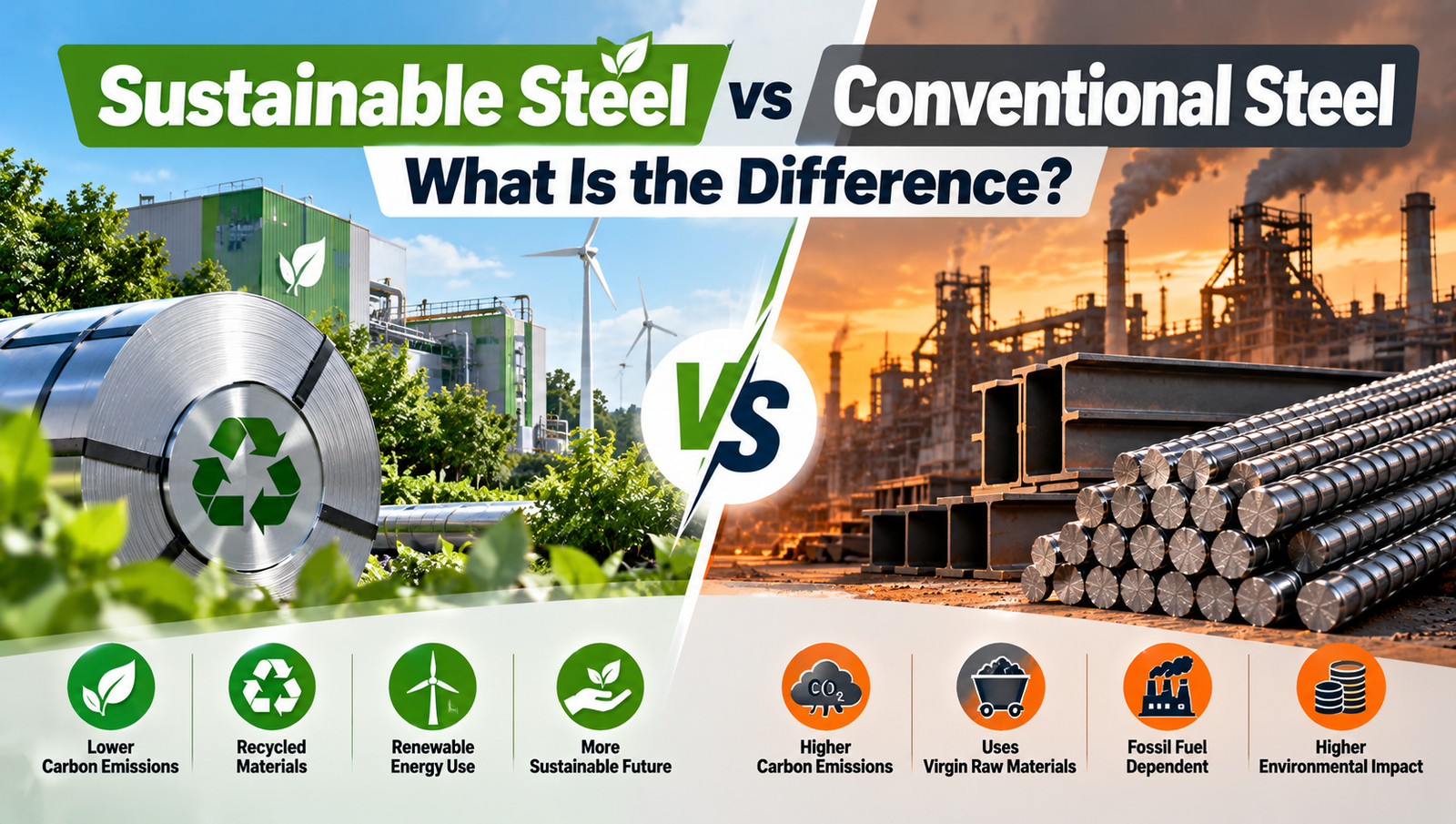

Sustainable Steel vs Conventional Steel: What Is the Difference?
Steel is one of the world’s most important construction and industrial materials. It is used in everything from homes and commercial buildings to bridges, factories, railways and renewable-energy infrastructure.
As industries focus more on reducing environmental impact, a growing question is:
What is the difference between sustainable steel and conventional steel?
The answer mainly relates to how steel is produced, what raw materials and energy sources are used, how much carbon is emitted during manufacturing, and how efficiently resources such as energy, water and scrap are used.
Sustainable steel does not mean that the finished material must have different structural properties. The focus is primarily on reducing the environmental impact associated with its production while maintaining the required quality, strength, durability and applicable standards.
This guide explains the difference between sustainable steel and conventional steel, how greener steel production works, the role of recycled scrap and DRI, and what these approaches mean for construction.
Quick Answer: Sustainable Steel vs Conventional Steel
Sustainable steel refers to steel produced using manufacturing practices designed to reduce environmental impact, such as increasing the use of recycled steel, improving energy efficiency, recovering waste heat, reducing water consumption and, depending on the production route, using lower-carbon energy or technologies.
Conventional steel refers broadly to established steelmaking routes that may rely more heavily on fossil fuels and virgin raw materials.
However, “sustainable” and “conventional” are broad descriptions rather than single manufacturing technologies. The environmental profile of steel depends on the actual production route, energy source, raw materials and plant-level practices.
| Factor | Sustainable Steel | Conventional Steel |
| Raw materials | May increase recycled steel and efficiently managed inputs | May rely more heavily on virgin raw materials depending on route |
| Energy efficiency | Focus on reducing energy use per tonne | Varies by plant and technology |
| Waste heat | Can be recovered and reused | Depends on plant systems |
| Water management | May include closed-loop and reduced-discharge systems | Depends on plant systems |
| Carbon emissions | Designed to reduce emissions relative to a relevant baseline | Varies significantly by production route |
| Manufacturing technology | May incorporate newer efficiency and lower-carbon technologies | Established production technologies |
| Recyclability | Steel remains highly recyclable | Steel remains highly recyclable |
The key point is that steel sustainability should be evaluated on the actual manufacturing process rather than simply on a product label.
What Is Sustainable Steel?
Sustainable steel is steel produced with a focus on reducing environmental impacts across the manufacturing process.
This can involve:
- Higher use of recycled steel
- More efficient steelmaking
- Reduced energy consumption
- Waste-heat recovery
- More efficient use of raw materials
- Reduced water consumption
- Closed-loop water systems
- Renewable electricity where available
- Lower-carbon production technologies
- Better resource recovery and waste management
The objective is to produce steel that meets the required performance and quality standards while reducing the environmental footprint of production.
Ambashakti’s Green Steel page describes its approach to lower-impact steelmaking, including recycled scrap, in-house DRI, waste-heat recovery, high-efficiency melting and zero-liquid-discharge systems.
What Is Conventional Steel?
Conventional steel refers to established steel production systems that have been used at industrial scale for many years.
Different conventional production routes exist, and their environmental impact is not identical.
A major traditional integrated route is based on producing iron from iron ore and then converting it into steel. Depending on the process, coal and other fossil fuels can play an important role.
Other steelmaking routes use electric furnaces and varying proportions of recycled steel.
Therefore, conventional steel should not automatically be treated as one single process, just as sustainable steel does not represent one single technology.
Sustainable Steel vs Conventional Steel: Key Differences
1. Raw Materials
One of the biggest differences can be the proportion and type of raw materials used.
Sustainable steelmaking can increase the use of recycled steel scrap, reducing the need for some virgin raw materials.
Ambashakti states that its Green Steel approach uses high-grade recycled steel scrap as a significant portion of the melting charge.
Its billet manufacturing information also describes steel scrap and sponge iron as key raw materials in its process.
Read more about Ambashakti Steel Billets.
2. Energy Efficiency
Steel manufacturing requires substantial energy.
A sustainable production approach seeks to improve how efficiently that energy is used.
Examples can include:
- Higher-efficiency furnaces
- Process optimisation
- Waste-heat recovery
- Better energy management
- Energy-efficient equipment
- Renewable electricity where available
Ambashakti states that waste gases from its DRI process are used through waste-heat recovery systems to generate captive power.
3. Carbon Emissions
Carbon emissions are one of the central issues in steel decarbonisation.
Different steelmaking routes have different emissions profiles. In general, reducing fossil-fuel consumption, increasing recycling, improving energy efficiency and adopting lower-carbon energy sources can help reduce the carbon intensity of steel production.
However, the precise carbon footprint should be evaluated using plant-specific data, boundaries and a defined measurement methodology.
This is why terms such as low-carbon steel, green steel and carbon-neutral steel should be supported by clear measurement and reporting rather than treated as interchangeable labels.
For a broader introduction, see What Is Green Steel?.
Is Sustainable Steel Stronger Than Conventional Steel?
Not necessarily.
Sustainability and mechanical performance are different attributes.
A TMT bar must meet the required mechanical and dimensional specifications regardless of whether the manufacturing process incorporates sustainability measures.
For example, Ambashakti states that its green-steel-related products meet the same IS 1786 requirements as conventional products while incorporating resource-efficiency measures in manufacturing.
For reinforcement applications, the grade, strength, ductility and other specifications should be checked separately from the environmental profile of the manufacturing process.
Explore Ambashakti TMT Bars for information about its reinforcement steel products.
What Makes Steel Production More Sustainable?
Several approaches can contribute to more sustainable steel production.
Recycled Steel Scrap
Steel is recyclable, and scrap can be remelted and converted into new steel products.
Using suitable recycled steel can reduce dependence on virgin raw materials in the appropriate production route.
Ambashakti identifies high-grade recycled scrap as one of the inputs used in its Green Steel approach.
Direct Reduced Iron
Direct Reduced Iron, or DRI, can be used as an iron-bearing input for steelmaking.
Ambashakti produces sponge iron through a direct-reduction route and describes DRI as a raw material used in its integrated steel manufacturing process.
For more information, explore Ambashakti Sponge Iron.
Waste-Heat Recovery
Waste heat generated during industrial processes can sometimes be recovered instead of being released unused.
Ambashakti states that its DRI operations use waste-heat recovery boilers to generate captive electricity.
This approach can improve overall energy utilisation.
Water Management
Water is another important resource in industrial manufacturing.
Closed-loop systems can reduce the need for fresh water and minimise process-water discharge.
Ambashakti’s Green Steel page describes a zero-liquid-discharge approach using closed-loop water circuits.
Sustainable Steel Manufacturing Process
There is no single manufacturing process that defines sustainable steel.
Different routes can incorporate different technologies and resource-efficiency measures.
A simplified sustainable steel manufacturing chain can include:
Raw Materials → Scrap/DRI Preparation → Steel Melting → Billet Casting → Rolling → Quality Testing → Finished Steel
At each stage, manufacturers can work on improving:
- Raw-material efficiency
- Energy efficiency
- Emissions
- Water usage
- Waste recovery
- Product consistency
Ambashakti describes an integrated production system connecting raw-material processing, sponge iron production, steelmaking, billet casting and rolling.
Sustainable Steel vs Conventional Steel for Construction
For construction buyers, the most important question is often whether sustainable steel can meet the same technical requirements as conventional steel.
The answer depends on the specific product and applicable standard.
A TMT bar should still meet the required:
- Grade
- Yield strength
- Tensile strength
- Ductility
- Dimensions
- Bend requirements
- Chemical requirements
- Applicable BIS/IS standard
Environmental performance can then be considered as an additional procurement criterion.
For example, Ambashakti states that its green-steel approach maintains applicable IS 1786 requirements for relevant TMT products.
Why Sustainable Steel Matters for Buildings
Steel is widely used in construction because of its strength, durability and versatility.
As developers and infrastructure projects increasingly consider environmental performance, the manufacturing footprint of construction materials can become part of procurement decisions.
Sustainable steel can contribute to construction projects that aim to:
- Reduce embodied carbon
- Improve resource efficiency
- Increase recycled-material use
- Support environmental targets
- Improve material traceability
- Reduce waste
However, the actual environmental benefit depends on the production process and verified data associated with the material.
Sustainable Steel vs Conventional Steel: Environmental Comparison
| Environmental Factor | Sustainable Production Approach | Conventional Production |
| Recycled material | Can increase the use of suitable scrap | Varies by production route |
| Energy efficiency | Explicit focus on improving efficiency | Varies by facility |
| Waste heat | Can be recovered for useful energy | Recovery depends on plant |
| Water | Can use closed-loop systems | Depends on facility |
| Carbon emissions | Can be reduced through technology and energy choices | Varies considerably by route |
| Resource efficiency | Often a specific production objective | Varies by plant |
| Product performance | Should still meet required technical standards | Should meet required technical standards |
This comparison should not be interpreted as every sustainable plant outperforming every conventional plant on every environmental metric.
Is Green Steel the Same as Sustainable Steel?
The terms are related but are not necessarily identical.
Sustainable steel is a broad concept covering environmental, resource-efficiency and, depending on the framework, wider sustainability considerations.
Green steel is commonly used for steel produced with substantially lower environmental or carbon impacts, although the exact definition can vary between organisations, markets and certification systems.
Low-carbon steel focuses more specifically on reducing greenhouse-gas emissions or carbon intensity.
Carbon-neutral steel generally implies that remaining emissions have been balanced or accounted for through a defined methodology, which makes the boundaries and accounting approach especially important.
For this reason, buyers should ask manufacturers how a sustainability claim is defined and measured.
Read Green Steel Manufacturing Process Explained for a deeper look at production processes.
How Ambashakti Approaches Sustainable Steel Production
Ambashakti’s Green Steel information identifies several measures used in its approach to lower-impact manufacturing:
Recycled Steel Scrap
High-grade recycled steel scrap is used as a significant portion of the melting charge.
In-House DRI
Captive sponge iron is used as an iron source with known chemical characteristics.
Waste-Heat Recovery
Waste gases from the DRI process are used in waste-heat recovery systems to generate captive electricity.
High-Efficiency Melting
Ambashakti describes high-efficiency induction furnaces as part of its manufacturing approach.
Water Recycling
The Green Steel page describes closed-loop water circuits and zero liquid discharge.
These measures form part of the company’s stated sustainability approach; their environmental impact should be evaluated using appropriate quantitative data and reporting boundaries.
From Sponge Iron to Finished TMT Bars
Understanding the production chain helps explain where sustainability measures can be introduced.
Ambashakti’s manufacturing information describes a sequence that includes:
Iron Ore / Raw Materials → Sponge Iron → Steel Melting → Billet Casting → Hot Rolling → TMT Treatment
Its TMT manufacturing information also describes billet heating, hot rolling and thermo-mechanical treatment before the finished reinforcement bar is produced.
You can explore the production chain through:
Why Billet Quality Matters
Billets are an important intermediate stage in the production of many long steel products.
Consistent billet quality can support consistency in the finished rolled product.
Ambashakti describes its billet production as part of an integrated manufacturing process covering raw materials, sponge iron, steelmaking, billet production and rolling.
Learn more about Steel Billets.
Sustainable Steel and TMT Bars
Sustainability does not eliminate the need for technical quality.
For reinforcement steel, buyers should still verify:
- TMT grade
- IS 1786 compliance
- Yield strength
- Tensile strength
- Ductility
- Bar diameter
- Weight
- Surface and rib pattern
- Quality documentation
- Traceability
Ambashakti’s TMT range includes products such as FE550, FE550D and FE550CRS, with product information covering manufacturing and quality-control processes.
Explore the FE550, FE550D and FE550CRS product pages.
How Sustainable Steel Can Support Green Construction
Green construction involves more than choosing one environmentally focused material.
A building’s environmental footprint can be influenced by:
- Cement and concrete
- Steel
- Glass
- Aluminium
- Energy systems
- Transportation
- Construction waste
- Building operation
- End-of-life recovery
Steel can contribute to sustainable construction because it is durable, versatile and recyclable.
Choosing steel produced with resource-efficiency measures can be one part of a broader sustainable-construction strategy.
For another perspective, read Understanding the Basics of TMT Rods and Their Importance in Construction.
What Should Buyers Ask About Sustainable Steel?
Before selecting a sustainable-steel product, buyers can ask manufacturers:
What percentage of recycled steel is used?
This helps understand the role of scrap in the production process.
What is the energy source?
Ask whether electricity comes from grid power, captive generation, renewable sources or a combination.
How is waste heat managed?
Waste-heat recovery can improve energy utilisation.
How is water managed?
Ask whether the plant uses recycling, closed-loop systems or discharge controls.
How is carbon intensity measured?
A meaningful sustainability comparison should have a clear measurement boundary and methodology.
Does the product meet the required standard?
Environmental claims should not replace technical certification and quality requirements.
Sustainable Steel vs Conventional Steel: Which Should Construction Buyers Consider?
The answer depends on the project’s procurement priorities and the available verified information.
If a project has environmental or embodied-carbon goals, buyers may want to evaluate:
- Carbon intensity
- Recycled content
- Energy efficiency
- Water management
- Manufacturing transparency
- Environmental certifications
- Product quality
- Availability
- Total delivered cost
At the same time, the selected steel must meet the project’s engineering and safety requirements.
Therefore, the most useful comparison is not simply “green versus conventional”, but:
Which specific steel product provides the required technical performance with the documented environmental profile that fits the project?
Frequently Asked Questions
What is sustainable steel?
Sustainable steel is steel produced using manufacturing practices intended to reduce environmental impacts through measures such as improved energy efficiency, increased recycling, resource conservation, waste recovery and lower-emission technologies.
What is conventional steel?
Conventional steel is a broad term for established steel production routes. Its environmental impact varies depending on the raw materials, furnace technology, energy source and plant efficiency.
Is sustainable steel stronger than conventional steel?
Not necessarily. Sustainability and mechanical strength are separate characteristics. The specific steel product must meet the required technical standard regardless of its production route.
Is green steel the same as sustainable steel?
Not exactly. Sustainable steel is a broader concept, while green steel is generally used for steel produced with substantially reduced environmental or carbon impacts. Definitions vary by organisation and certification framework.
Does sustainable steel cost more?
Not always. Cost depends on the production technology, raw materials, energy, market conditions, product specification, scale and location. Buyers should compare the full delivered cost of equivalent products.
Can sustainable steel be used for house construction?
Yes, provided the specific steel product meets the required engineering specifications and applicable standards for the project.
What is low-carbon steel?
Low-carbon steel generally refers to steel produced with a lower greenhouse-gas emissions intensity than a defined conventional or baseline production route. The exact definition and measurement boundary should be checked.
What is carbon-neutral steel?
Carbon-neutral steel generally refers to steel for which remaining greenhouse-gas emissions are balanced or accounted for through a defined methodology. Buyers should examine the accounting boundary and evidence supporting a carbon-neutral claim.
How does recycled scrap make steel more sustainable?
Recycling steel can reduce the requirement for some virgin raw materials and can contribute to more resource-efficient steelmaking. The overall benefit depends on the production route, energy source and other process factors.
How is Ambashakti making its steel production more sustainable?
Ambashakti states that its Green Steel approach includes recycled scrap, in-house DRI, waste-heat recovery, high-efficiency melting and closed-loop water management with zero liquid discharge.
Related Ambashakti Resources
What Is Green Steel? Benefits, Manufacturing Process & Future Applications
Understand the meaning of green steel, its manufacturing approaches, benefits and potential applications.
Green Steel Manufacturing Process Explained
Learn how raw materials move through steelmaking, billet production and finished steel manufacturing, and where lower-impact practices can be introduced.
Read the Green Steel Manufacturing Guide
Green Steel at Ambashakti
Explore Ambashakti’s stated approach to recycled scrap, DRI, waste-heat recovery, efficient melting and water management.
Explore Ambashakti Green Steel
TMT Bars
Learn about Ambashakti’s TMT grades, manufacturing process, specifications and construction applications.
Steel Billets
Understand billet manufacturing and its role in producing finished steel products.
Sponge Iron
Learn how DRI/sponge iron is produced and how it functions as a raw material in steelmaking.
Steel Plants
Explore Ambashakti’s manufacturing footprint and integrated steel-production facilities.
Final Takeaway
The difference between sustainable steel and conventional steel is primarily related to the way steel is produced and the resources, energy and technologies used during manufacturing.
Sustainable production can involve higher recycled-material use, improved energy efficiency, waste-heat recovery, water recycling and lower-carbon technologies. Conventional steelmaking covers a range of established production routes, so its environmental performance can vary significantly from one plant to another.
For construction buyers, sustainability should be evaluated alongside strength, ductility, applicable standards, quality, traceability, availability and cost.
Ambashakti’s stated Green Steel approach combines recycled steel scrap, in-house DRI, waste-heat recovery, efficient melting and closed-loop water management.
For more information, explore Ambashakti Green Steel and the Ambashakti TMT Bars range.
COMBINED SCHEMA
One important correction before implementation
The image and publisher.logo URLs above should ideally be replaced with the actual blog featured-image URL and Ambashakti logo URL