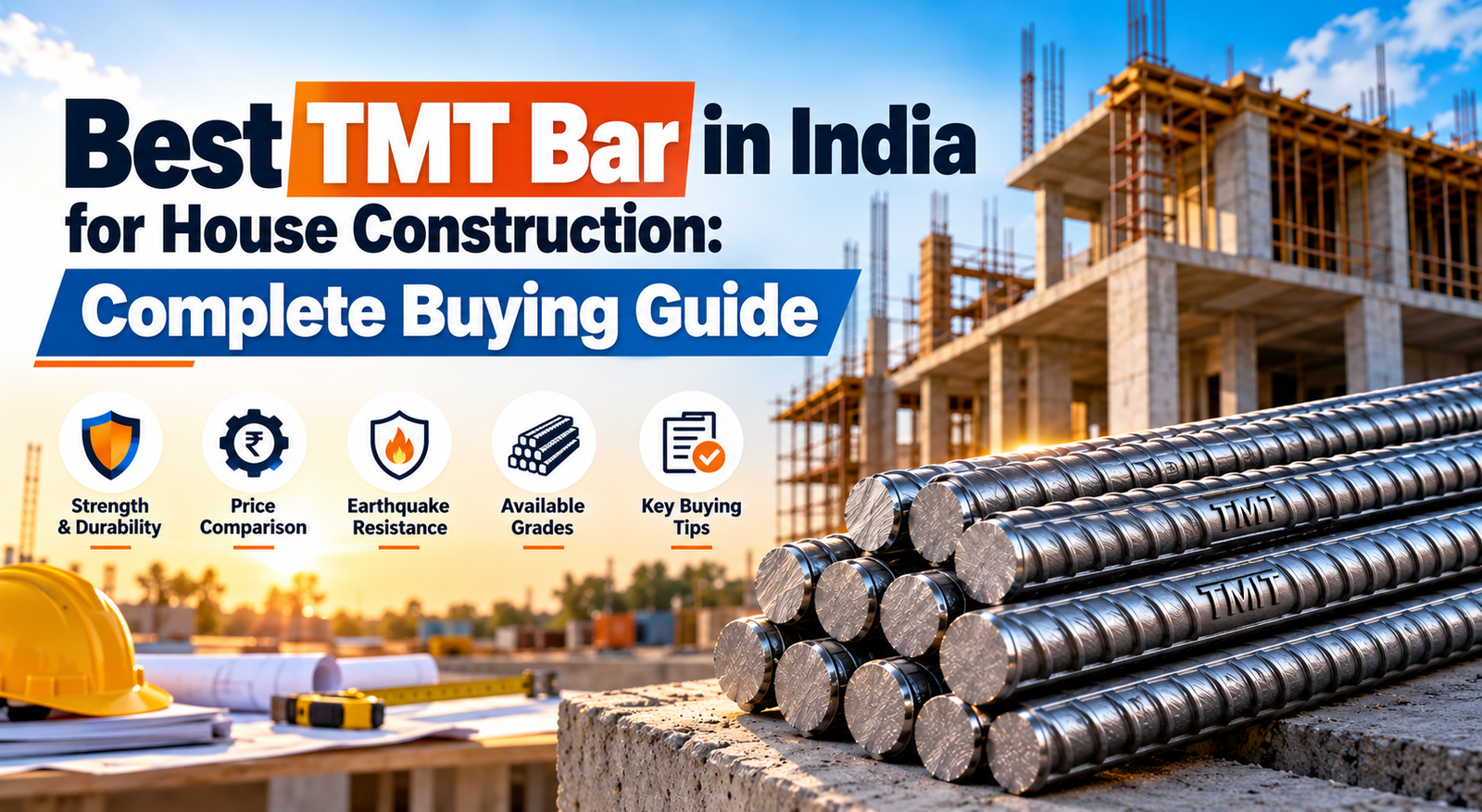

Best TMT Bar in India for House Construction (2026): Grades, Sizes and What to Check
Last updated: 06 November 2026 · Technically reviewed by: Rishika
The short answer
For most houses in India, the grade is chosen from Fe500, Fe500D, Fe550D or Fe550CRS, and the structural engineer’s drawing makes the final call. As a practical starting point:
- Fe500D is the most widely specified ductile grade for ordinary residential buildings, especially in earthquake-prone regions.
- Fe550D suits designs that need higher strength and ductility, such as taller or heavily loaded buildings.
- Fe550CRS is the one to consider near the coast or in humid, corrosion-prone locations.
- Plain Fe500 can be acceptable for low-rise, non-seismic designs if the engineer specifies it.
Whichever grade you choose, buy only BIS-certified bars from a verified dealer, and check the grade, diameter and weight on delivery.
Which grade for which situation?
| Your situation | Grades usually considered | Why |
| Low-rise house, low seismic risk | Fe500 or Fe500D | Common, well-understood grades for standard RCC work |
| House in a seismic zone (Delhi NCR has long been placed in Seismic Zone IV) | Fe500D or Fe550D | Ductile detailing practice (IS 13920) favours ductile “D” grades in higher seismic zones |
| Taller building or higher loads | Fe550D | Higher yield strength with ductility retained |
| Coastal, humid or aggressive environment | Fe550CRS | Added corrosion resistance protects the steel over the building’s life |
This table is a guide for discussion with your engineer. It is not a substitute for the structural design.
Fe500 vs Fe500D vs Fe550 vs Fe550D
The numbers after “Fe” show the minimum yield strength in N/mm². The letter “D” marks higher ductility, meaning the bar stretches more before it breaks.
| Grade | Min. yield strength | Min. elongation | What it means for a house |
| Fe500 | 500 N/mm² | 12% | Standard strength, lower ductility requirement |
| Fe500D | 500 N/mm² | 16% | Same strength as Fe500, but far better ductility |
| Fe550 | 550 N/mm² | 10% | Higher strength, lower elongation |
| Fe550D | 550 N/mm² | 14.5% | Higher strength with the ductility needed for seismic performance |
Values are minimums from IS 1786:2008 as amended. Check the current BIS edition and the mill test certificate for the bars you buy.
Two points explain most buying mistakes:
- A higher number is not automatically better. Fe550 has higher strength than Fe500D but lower minimum elongation. In a house where ductility matters, Fe550D or Fe500D is usually the safer reading of the drawing, not plain Fe550.
- Never swap grades on site. If the drawing says Fe500D, a supplier cannot substitute Fe500 without the engineer’s written approval.
What is a TMT bar?
TMT stands for Thermo-Mechanically Treated. After rolling, the bar is rapidly cooled and then self-tempered, which gives it a hard outer layer and a softer, more ductile core. Concrete is strong in compression and weak in tension, so these ribbed steel bars carry the tensile forces inside beams, slabs, columns and foundations.
For more technical background, see Ambashakti’s TMT Facts.
TMT bar sizes and weights
The unit weight of a bar follows the formula D² ÷ 162 kg per metre, where D is the diameter in mm. You can use it to check the weight of a bundle on delivery.
| Diameter | Weight per metre | Commonly seen in residential designs (indicative) |
| 8 mm | 0.395 kg | Stirrups, ties, slab distribution bars |
| 10 mm | 0.617 kg | Slab bars, stirrups |
| 12 mm | 0.888 kg | Slab and beam bars, smaller columns |
| 16 mm | 1.580 kg | Beams, columns, footings |
| 20 mm | 2.470 kg | Columns and footings in larger houses |
| 25 mm | 3.850 kg | Heavily loaded members |
| 32 mm | 6.310 kg | Rare in houses; larger structures |
| 40 mm | 9.860 kg | Rare in houses; larger structures |
The “commonly seen” column is only a pattern. The actual diameters and spacing come from your structural drawings and bar bending schedule, not from the size of the house. For the full chart, see the TMT bar weight chart (8 mm to 32 mm). To estimate quantity, read TMT bar quantity calculation and how much steel a 1,000 sq. ft. house needs.
How to choose TMT bars: 6 checks
- Standard and certification. The bars should comply with IS 1786 and carry the BIS (ISI) mark. Ask for the licence details and confirm them against the product documentation instead of relying on a verbal claim.
- Grade. It must match the drawing exactly, including any “D” or “CRS” suffix.
- Ductility. Ask the engineer whether a ductile grade is required for your seismic zone.
- Corrosion exposure. For coastal or very humid sites, ask about a corrosion-resistant grade such as Fe550CRS.
- Weight and dimensions. Weigh a sample length and compare it with the table above.
- Source. Buy from an authorised dealer and keep the invoice and test certificate.
How to check bars on delivery
- Look for the brand name and grade embossed on the bar at regular intervals, not just a sticker on the bundle.
- Check the bundle tag for the BIS mark, grade, diameter, heat or batch number and the manufacturer’s name.
- Inspect ribs. They should be even, sharp and consistent along the bar.
- Cut a one-metre sample and weigh it against the formula above.
- Look for heavy rust, pitting, cracks or bends. A thin surface film is normal; flaking rust is not.
- For a large order, ask for the mill test certificate that matches the heat or batch number on your bundles.
For a longer checklist, read How to identify original TMT bars before buying.
How to compare TMT brands fairly
Brand names matter less than whether the specific product meets your design. Ask every brand, including us, for the same things:
| Compare | What to ask for |
| Grade availability | Is the exact grade on your drawing (for example Fe500D or Fe550D) sold in your city? |
| Certification | BIS licence details for that grade and diameter |
| Test documentation | Mill test certificate with yield strength, UTS and elongation |
| Ductility and corrosion options | “D” and CRS variants where your site needs them |
| Supply | Dealer in your area, delivery time and bundle tagging |
| Price | Rate for your grade, diameter and quantity, with taxes and transport shown |
For a wider look at leading manufacturers, see our Top 10 TMT bars in India 2026.
Ambashakti TMT bars for houses
Ambashakti’s TMT range covers three products:
- Amba Flexion Fe550D, a high-strength, high-ductility bar for demanding RCC work.
- Amba Flexion Fe550CRS, a corrosion-resistant bar for coastal, humid or aggressive environments.
- Amba Shakti SD Fe550, a high-strength bar for higher-load applications.
To find a supplier near you, use Find a Dealer, or see the full TMT bar range.
What does steel cost for a house?
There is no single national rate. TMT prices change with grade, diameter, quantity, location, raw material cost, transport and taxes. Compare quotes for the same grade and diameter, not just the lowest number. Check current rates on our TMT bar price page, or look up your city’s page from the price menu. For the bigger picture, read TMT bar price vs total construction cost.
Common mistakes to avoid
- Choosing only by price or by brand name.
- Assuming the highest grade is the best grade.
- Accepting a different grade or diameter from the one on the drawing.
- Skipping the BIS mark, bundle tag and test certificate.
- Buying from an unverified seller.
- Not weighing or inspecting the material on delivery.
Frequently asked questions
Which is the best TMT bar for house construction in India?
The best bar is the one that matches your structural drawing and carries valid BIS certification. For most homes that means a grade like Fe500D, or Fe550D where the design needs higher strength. Near the coast, Fe550CRS is worth considering.
Is Fe500D better than Fe500 for a house?
Fe500D has the same 500 N/mm² yield strength but a higher minimum elongation (16% against 12%). That extra ductility is valuable in seismic regions, so it is commonly preferred. Your engineer’s specification decides.
Can I use Fe550 for a residential building?
Yes, if the design calls for it. If ductility also matters, as it does in seismic zones, ask whether Fe550D is the intended grade instead of plain Fe550.
Is Fe550D suitable for a house?
Yes. Fe550D gives high strength with higher ductility, and it can reduce steel quantity when the engineer designs for the higher yield strength. It should be used only where the drawings specify it.
Which TMT bar size is best for a house?
There is no single best size. Slabs, beams, columns and foundations each use different diameters according to the design, commonly in the 8 mm to 20 mm range for houses.
How can I check if a TMT bar is genuine?
Look for the embossed brand and grade on the bar, a BIS mark and batch details on the tag, even ribs, and a weight that matches D² ÷ 162 per metre. For larger orders, request the mill test certificate.
Does a higher TMT grade mean a stronger house?
No. The structure’s strength depends on the design, concrete quality, bar placement and cover. A higher grade only helps if the structure is designed for it.
Should I buy by brand or by grade?
Start with the grade and certification your design needs, then compare brands that offer that exact product with proper documentation.
How can I buy Ambashakti TMT bars?
See the TMT bar range and use Find a Dealer, or request a quote through Contact Us.
Related reading
- TMT bar weight chart: 8 mm to 32 mm
- TMT bar quantity calculation
- Steel required for a 1,000 sq. ft. house
- How to identify original TMT bars
- Fe500 vs Fe550 vs Fe550D: which grade is best?
- Sariya rate today
Final takeaway
The best TMT bar for your house is not the strongest or the most famous one. It is the bar whose grade, ductility and certification match the structural design, and which you have verified on delivery. Confirm the grade with your engineer, buy from an authorised dealer, and check the markings, weight and test certificate before the steel goes into the structure.