
Introduction
Government construction projects are designed to deliver safe, durable and long-lasting infrastructure. Highways, bridges, flyovers, railway infrastructure, metro systems, government buildings, industrial facilities and public utility projects all depend on properly specified and tested construction materials.
TMT bars used in government construction projects must comply with the applicable project specifications, relevant Indian Standards, specified steel grade and required quality-assurance procedures. In India, IS 1786:2008 is the key Indian Standard covering high-strength deformed steel bars and wires for concrete reinforcement, and BIS lists the standard under mandatory certification.
For government departments, public-sector organisations, contractors, consultants and infrastructure developers, selecting reinforcement steel is therefore not simply a matter of comparing prices. The grade, mechanical properties, chemical composition, dimensions, certification, testing, traceability and project-specific requirements all need to be considered.
This guide explains IS 1786, BIS certification, TMT bar grades, quality testing and procurement considerations for government and infrastructure construction projects in India.
What Are TMT Bars and Why Are They Important in Government Construction?
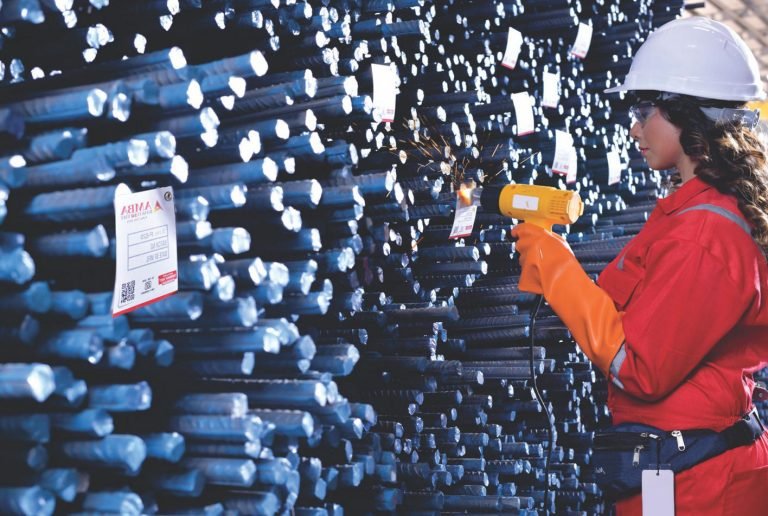
Thermo-Mechanically Treated (TMT) bars are reinforcement steel products used with concrete in reinforced concrete structures.
Concrete provides high compressive strength but has comparatively limited tensile resistance. TMT reinforcement helps provide the tensile capacity required by structural members and contributes to the overall performance of reinforced concrete construction.
TMT bars are commonly used in:
- Highways and expressways
- Bridges and flyovers
- Railway infrastructure
- Metro projects
- Government offices
- Schools and hospitals
- Industrial structures
- Public utility infrastructure
- Water infrastructure
- Residential and commercial structures
The appropriate grade and diameter depend on the structural design, applicable codes, environmental exposure, project specifications and approved construction methodology.
For large infrastructure projects, consistent steel quality is particularly important because reinforcement is an integral part of the structural system.
What is IS 1786 for TMT Bars?
IS 1786:2008 is the Indian Standard for high-strength deformed steel bars and wires used for concrete reinforcement.
The official Bureau of Indian Standards (BIS) standard information identifies IS 1786:2008 as “High Strength Deformed Steel Bars and Wires for Concrete Reinforcement — Specification” and lists it under mandatory certification.
The standard establishes technical requirements for reinforcement steel, including requirements relating to:
- Steel grades
- Mechanical properties
- Tensile strength
- Yield strength
- Elongation
- Bend performance
- Re-bend performance
- Chemical composition
- Dimensions
- Mass and tolerances
- Identification and marking
The applicable edition and amendments should always be verified before procurement.
Official reference:
BIS – IS 1786:2008 Standard Details
What TMT Bar Grades Are Covered Under IS 1786?
IS 1786:2008 covers different reinforcement steel grades designed to provide different combinations of strength and ductility.
The official BIS material identifies grades including Fe415, Fe415D, Fe500, Fe500D, Fe550, Fe550D and Fe600.
| TMT Grade | Specified Minimum Yield Strength | General Consideration |
| Fe415 | 415 MPa | Used where specified by structural design |
| Fe415D | 415 MPa | Higher specified elongation requirements |
| Fe500 | 500 MPa | High-strength reinforcement |
| Fe500D | 500 MPa | High-strength reinforcement with enhanced ductility requirements |
| Fe550 | 550 MPa | Higher-strength reinforcement |
| Fe550D | 550 MPa | Higher strength with enhanced ductility requirements |
| Fe600 | 600 MPa | Very high-strength reinforcement where specified |
The “Fe” number broadly represents the specified minimum yield strength in MPa, while the “D” designation represents the corresponding grade with enhanced specified minimum elongation requirements.
However, the highest-strength grade is not automatically the best choice for every project.
The appropriate grade must be determined by the structural designer and the applicable project specifications.
Official reference:
BIS – IS 1786:2008 Standard Preview
What Is BIS Certification for TMT Bars?
The Bureau of Indian Standards (BIS) is India’s national standards body and operates product certification schemes for products covered by Indian Standards.
For products covered by IS 1786, BIS certification provides a conformity-assessment framework for manufacturers whose products fall within the applicable certification requirements.
For buyers, contractors and project quality teams, BIS certification should be treated as one part of a broader material-approval process.
A project team should verify:
- The applicable Indian Standard.
- The manufacturer’s BIS licence.
- The validity of the licence.
- The product and grade covered by the licence.
- The relevant sizes or product scope.
- The identification and marking on the supplied material.
- The manufacturer’s test documentation.
- The project-specific inspection and acceptance requirements.
A printed certification claim should not be treated as sufficient by itself. The applicable BIS licence and product scope should be independently verified.
Official reference:
BIS Scheme-I – ISI Mark Scheme
How to Verify BIS Certification of TMT Bars
Before accepting TMT bars for a government or infrastructure project, procurement and quality teams should verify the manufacturer’s certification information.
Step 1: Identify the manufacturer
Check the manufacturer’s name, manufacturing location and product identification.
Step 2: Verify the BIS licence
Use official BIS resources to check the applicable licence information.
Step 3: Check the product scope
The licence should cover the relevant product, grade and applicable dimensions.
Step 4: Match the delivered material
The grade, size, manufacturer and identification on the delivered steel should correspond with the approved procurement documentation.
Step 5: Review test certificates
Check the manufacturer’s test certificate or material test certificate against the applicable grade and project requirements.
Step 6: Complete project inspection
Follow the project’s approved inspection and testing plan before releasing the material for structural use.
TMT Bar Quality Requirements for Government Projects
Government and infrastructure projects may involve several levels of quality control.
The exact requirements depend on the department, tender, contract, technical specifications, structural design and inspection plan.
Important quality parameters can include the following.
1. Mechanical Properties
Mechanical testing helps determine whether reinforcement steel meets the specified strength and deformation requirements.
Depending on the applicable requirements, testing may include:
- Yield strength
- Tensile strength
- Percentage elongation
- Tensile-to-yield strength relationship
- Bend test
- Re-bend test
These tests help establish whether the material conforms to the specified grade.
2. Chemical Composition
Chemical composition can influence the steel’s mechanical characteristics, fabrication behaviour and suitability for particular applications.
Depending on the applicable grade and requirements, chemical analysis may consider:
- Carbon
- Manganese
- Sulphur
- Phosphorus
- Carbon equivalent
Carbon equivalent can be particularly relevant when weldability is being evaluated.
Welding of reinforcement should only be undertaken where permitted by the structural design, applicable standards and approved welding procedures.
3. Dimensions and Mass
TMT bars should comply with the applicable requirements for nominal diameter, mass and dimensional tolerances.
Quality teams may check:
- Nominal diameter
- Mass per unit length
- Dimensional consistency
- Length
- Surface condition
- Identification and markings
Correct dimensions are important for reinforcement scheduling, quantity control and structural detailing.
4. Surface Condition and Rib Pattern
TMT bars are manufactured with surface ribs that help provide mechanical interlock with concrete.
Delivered reinforcement should be inspected for unacceptable defects, damage or severe corrosion.
Surface condition should be evaluated according to the applicable standard and project acceptance criteria rather than relying on visual assumptions alone.
5. Traceability and Documentation
Traceability helps project teams connect delivered reinforcement to its manufacturer, production batch or heat, test results and delivery records, where applicable.
Typical project documentation may include:
- Purchase order
- Approved technical specifications
- BIS licence information
- Manufacturer’s test certificate
- Batch or heat identification
- Delivery challan
- Inspection records
- Laboratory test reports
- Material approval records
- Non-conformance records, where applicable
The exact documentation requirements should be established in the project quality plan and contract.
How Are TMT Bars Tested for Government Construction Projects?
A typical TMT bar quality-control process can include the following stages.
Step 1: Document Verification
The project team checks the supplied grade, size, manufacturer, certification information and test documents.
Step 2: Sampling
Samples are selected according to the applicable standard, contract and inspection plan.
Step 3: Mechanical Testing
The required tensile, bend, re-bend and other applicable tests are performed.
Step 4: Chemical Testing
Chemical composition and other applicable parameters are tested when required.
Step 5: Result Evaluation
The test results are compared with the applicable acceptance criteria.
Step 6: Material Approval
The authorised project representative records acceptance or handles any non-conformance according to the approved procedure.
Testing frequency should not be assumed to be identical for every government project. It should follow the applicable contract, inspection plan, standard and project requirements.
BIS also maintains a Laboratory Information Management System that can be used to identify laboratories and testing scopes associated with particular Indian Standards.
Official reference:
BIS Laboratory Information Management System – IS 1786
How to Select the Right TMT Bar Grade for Infrastructure Projects
TMT bar selection should start with the approved structural design and project specifications.
The following factors should be evaluated:
- Structural loading
- Required yield strength
- Ductility
- Seismic requirements
- Reinforcement detailing
- Concrete grade
- Environmental exposure
- Corrosion risk
- Fabrication requirements
- Applicable Indian Standards
- Project-specific specifications
TMT Bars for Highways and Expressways
Highway structures can include reinforced concrete pavements, bridges, culverts, retaining structures, flyovers and associated infrastructure.
The reinforcement grade should be selected according to the approved design and project specifications.
TMT Bars for Bridges
Bridge projects can involve demanding structural and environmental conditions.
Engineers may need to evaluate:
- Strength
- Ductility
- Exposure conditions
- Reinforcement detailing
- Durability requirements
- Corrosion protection
TMT Bars for Metro and Railway Projects
Metro systems and railway infrastructure can include stations, viaducts, foundations, retaining structures and other reinforced concrete elements.
The selected reinforcement should meet the project’s approved technical specifications and inspection requirements.
TMT Bars for Government Buildings
Schools, hospitals, offices and other public buildings require reinforcement steel appropriate to the approved structural design and applicable building and material standards.
Fe550 vs Fe550D: What Is the Difference?
Fe550 and Fe550D both belong to the 550 MPa strength category, but they should not be treated as identical grades.
The Fe550D grade has enhanced specified elongation requirements compared with the corresponding Fe550 category.
This distinction can become important where structural design requirements place greater emphasis on ductility.
The correct grade should always be selected according to the structural engineer’s specifications and the applicable project requirements.
For more information, explore:
When Should Fe550 CRS Be Considered?
Corrosion-resistant reinforcement can be considered for structures exposed to aggressive environmental conditions, including certain coastal and marine environments.
However, Fe550 CRS should not automatically be considered necessary for every government or infrastructure project.
The requirement should be determined through the project’s durability strategy and structural specifications.
Factors that may need to be evaluated include:
- Environmental exposure
- Chloride exposure
- Moisture
- Concrete quality
- Concrete cover
- Structural detailing
- Corrosion protection measures
- Expected service life
- Applicable project specifications
Explore the Ambashakti Fe550 CRS product:
TMT Bar Procurement Checklist for Government Projects
Before approving TMT bars for a government or infrastructure project, procurement and quality teams can use this checklist:
- Confirm the specified TMT grade.
- Confirm the required bar diameter.
- Review the approved technical specification.
- Verify the applicable BIS certification.
- Check the manufacturer’s BIS licence and scope.
- Review the manufacturer’s test certificate.
- Verify batch or heat identification where applicable.
- Inspect delivered material.
- Check dimensional and mass requirements.
- Conduct required laboratory testing.
- Maintain material traceability.
- Record inspection and approval.
- Follow the project’s non-conformance procedure where required.
- Store reinforcement appropriately before use.
Common Mistakes When Procuring TMT Bars for Government Projects
Choosing Steel Only on Price
Price is only one procurement consideration. Compliance, quality, documentation and project suitability must also be evaluated.
Assuming a Higher Grade Is Always Better
A higher yield strength does not automatically make a grade appropriate for every structure. The structural design determines the required material.
Accepting Certification Claims Without Verification
BIS certification claims should be verified through official BIS resources.
Ignoring Test Certificates
Material test documentation provides important evidence of conformity and should be reviewed against the project requirements.
Using the Same Testing Plan for Every Project
Testing requirements can vary according to the contract, project specifications, inspection plan and applicable standards.
Selecting Corrosion-Resistant Steel Without Assessing Exposure
Corrosion-resistant reinforcement should be considered as part of the project’s overall durability strategy.
Losing Material Traceability
Poor documentation can make it difficult to identify the source and test history of reinforcement material.
Why Quality Matters in Government Infrastructure Projects
Government infrastructure represents a long-term investment in public safety, mobility and economic development.
A road, bridge, railway structure, public building or water infrastructure project may remain in service for decades. The quality of materials used during construction can therefore have implications beyond the construction phase.
A robust material-quality process helps project teams:
- Verify material conformity
- Reduce the risk of non-conforming steel
- Maintain procurement records
- Support quality audits
- Improve material traceability
- Maintain consistency across large projects
- Support long-term structural performance
For this reason, TMT bar selection should be based on technical suitability, applicable standards, certification and documented quality assurance—not price alone.
Why Choose Ambashakti TMT Bars?
Ambashakti has been associated with steel manufacturing since 1974 and manufactures steel products for construction applications.
Its TMT product range includes grades such as Fe550, Fe550D and Fe550 CRS, subject to the applicable product specifications and certification requirements.
For contractors, developers and infrastructure project teams, Ambashakti TMT products can be evaluated against the project’s approved technical requirements, including:
- Required TMT grade
- Applicable Indian Standard
- Product specifications
- Certification requirements
- Testing requirements
- Project-specific quality documentation
Explore the Ambashakti range:
Final material approval should always be based on the applicable project specifications, verified certification and the requirements established by the project authority and design team.
Frequently Asked Questions
1. Which IS code applies to TMT bars used in government construction projects?
IS 1786:2008 is the principal Indian Standard covering high-strength deformed steel bars and wires for concrete reinforcement. The latest applicable edition, amendments and project-specific requirements should be verified before procurement.
2. Is BIS certification mandatory for TMT bars?
BIS lists IS 1786:2008 under mandatory certification. Buyers should verify the applicable certification requirements and manufacturer’s licence through official BIS resources.
3. What is the difference between IS 1786 and BIS certification?
IS 1786 establishes technical requirements for covered reinforcement steel. BIS certification provides the applicable conformity-assessment framework for manufacturers covered by the certification scheme.
4. Which TMT grade is best for government projects?
There is no single TMT grade that is best for every government project. The appropriate grade—such as Fe500, Fe500D, Fe550 or Fe550D—depends on the structural design and applicable project specifications.
5. What is the difference between Fe550 and Fe550D?
Both are 550 MPa strength-category grades, but Fe550D has enhanced specified elongation requirements. The appropriate grade should be selected according to the approved structural design.
6. Are Fe550 TMT bars suitable for infrastructure projects?
Fe550 can be suitable for infrastructure applications where the structural design and project specifications permit its use. The material must also satisfy applicable quality and certification requirements.
7. What tests are performed on TMT bars?
Depending on the applicable requirements, testing may include yield strength, tensile strength, elongation, bend, re-bend, chemical composition, dimensions and mass.
8. What documents should accompany TMT bars supplied to a government project?
Requirements vary by project but may include the manufacturer’s test certificate, applicable BIS licence information, batch or heat identification, delivery documentation, inspection records and laboratory reports.
9. Can contractors use any BIS-marked TMT bar for a government project?
Not necessarily. The material must also meet the project’s approved grade, size, technical specifications, certification scope and acceptance criteria.
10. When should corrosion-resistant TMT bars be considered?
They may be considered for certain aggressive exposure conditions, including some coastal and marine environments. The decision should be based on the project’s structural and durability requirements.
11. How can buyers verify a TMT manufacturer’s BIS licence?
Buyers should use official BIS resources to verify the licence, its validity and its applicable product scope before procurement.
12. Why is IS 1786 important for TMT bars?
IS 1786 establishes technical requirements that provide a common basis for evaluating high-strength deformed reinforcement steel used in concrete construction.
Official Standards & References
The following official resources should be used when verifying standards, certification and testing information.
Bureau of Indian Standards – IS 1786:2008
Official BIS standard details for IS 1786:2008 – High Strength Deformed Steel Bars and Wires for Concrete Reinforcement.
BIS – IS 1786:2008 Standard Details
BIS Product Manual – IS 1786:2008
Official BIS product manual containing certification-related information for products covered by IS 1786:2008.
BIS Product Manual – IS 1786:2008
BIS – IS 1786:2008 Standard Preview
Official BIS document providing information about the standard and covered grades.
BIS Scheme-I – ISI Mark Scheme
Official BIS information relating to the Scheme-I product certification framework.
BIS Scheme-I – ISI Mark Scheme
BIS Laboratory Information Management System
Official BIS laboratory database for searching testing information associated with Indian Standards, including IS 1786.
BIS LIMS – IS 1786 Testing Information
Important Note
This article provides general technical and educational information about TMT bars, IS 1786 and BIS certification.
Government departments, public-sector organisations, consultants, contractors and procurement teams should always refer to the latest applicable BIS standards and amendments, tender conditions, approved technical specifications, structural drawings, inspection plans and project-specific quality requirements before purchasing or approving reinforcement steel.
Product selection should be based on the approved structural design and applicable project requirements rather than grade strength alone.
Conclusion
TMT bars are a critical reinforcement material in India’s government and infrastructure construction projects. IS 1786 provides the principal Indian Standard framework for high-strength deformed steel reinforcement, while BIS certification, material testing, documentation and project-level inspection help support quality assurance.
For contractors, engineers, consultants and procurement teams, the right approach is to:
Specify the correct grade → verify BIS certification → check material documentation → test as required → maintain traceability → approve according to project specifications.
For infrastructure projects requiring high-strength reinforcement, Fe550, Fe550D and corrosion-resistant reinforcement options such as Fe550 CRS may be considered where they meet the approved structural and project requirements.
Ambashakti’s TMT range can be evaluated against these requirements through its relevant product specifications and technical documentation.
For more information, explore Ambashakti TMT Bars and the individual Fe550, Fe550D and Fe550 CRS product pages.